from d2l import torch as d2l
import torch
from torch import nn
from torch.nn import functional as F9.6 Concise Implementation of Recurrent Neural Networks
Like most of our from-scratch implementations, Section 9.5 was designed to provide insight into how each component works. But when you are using RNNs every day or writing production code, you will want to rely more on libraries that cut down on both implementation time (by supplying library code for common models and functions) and computation time (by optimizing the heck out of these library implementations). This section will show you how to implement the same language model more efficiently using the high-level API provided by your deep learning framework. We begin, as before, by loading The Time Machine dataset.
from d2l import tensorflow as d2l
import tensorflow as tf
from d2l import jax as d2l
from flax import linen as nn
from jax import numpy as jnpfrom d2l import mxnet as d2l
from mxnet import np, npx
from mxnet.gluon import nn, rnn
npx.set_np()9.6.1 Defining the Model
We define the following class using the RNN implemented by high-level APIs.
Flax does not provide an RNNCell for concise implementation of Vanilla RNNs as of today. There are more advanced variants of RNNs like LSTMs and GRUs which are available in the Flax linen API.
Specifically, to initialize the hidden state, we invoke the member method begin_state. This returns a list that contains an initial hidden state for each example in the minibatch, whose shape is (number of hidden layers, batch size, number of hidden units). For some models to be introduced later (e.g., long short-term memory), this list will also contain other information.
class RNN(d2l.Module):
    """The RNN model implemented with high-level APIs."""
    def __init__(self, num_inputs, num_hiddens):
        super().__init__()
        self.save_hyperparameters()
        self.rnn = nn.RNN(num_inputs, num_hiddens)

    def forward(self, inputs, H=None):
        return self.rnn(inputs, H)
class RNN(d2l.Module):
"""The RNN model implemented with high-level APIs."""
def __init__(self, num_hiddens):
super().__init__()
self.save_hyperparameters()
self.rnn = tf.keras.layers.SimpleRNN(
num_hiddens, return_sequences=True, return_state=True)
def forward(self, inputs, H=None):
# inputs: (time_steps, batch_size, features) -> (batch_size, time_steps, features)
outputs, H = self.rnn(tf.transpose(inputs, perm=[1, 0, 2]), H)
return tf.transpose(outputs, perm=[1, 0, 2]), Hclass RNN(nn.Module):
"""The RNN model implemented with high-level APIs."""
num_hiddens: int
@nn.compact
def __call__(self, inputs, H=None):
raise NotImplementedErrorclass RNN(d2l.Module):
"""The RNN model implemented with high-level APIs."""
def __init__(self, num_hiddens):
super().__init__()
self.save_hyperparameters()
self.rnn = rnn.RNN(num_hiddens)
def forward(self, inputs, H=None):
if H is None:
H, = self.rnn.begin_state(inputs.shape[1], ctx=inputs.ctx)
outputs, (H, ) = self.rnn(inputs, (H, ))
return outputs, HInheriting from the RNNLMScratch class in Section 9.5, the following RNNLM class defines a complete RNN-based language model. Note that we need to create a separate fully connected output layer.
class RNNLM(d2l.RNNLMScratch):
    """The RNN-based language model implemented with high-level APIs."""
    def init_params(self):
        self.linear = nn.LazyLinear(self.vocab_size)

    def output_layer(self, hiddens):
        return d2l.swapaxes(self.linear(hiddens), 0, 1)
class RNNLM(d2l.RNNLMScratch):
"""The RNN-based language model implemented with high-level APIs."""
def init_params(self):
self.linear = tf.keras.layers.Dense(self.vocab_size)
def output_layer(self, hiddens):
return d2l.transpose(self.linear(hiddens), (1, 0, 2))class RNNLM(d2l.RNNLMScratch):
"""The RNN-based language model implemented with high-level APIs."""
training: bool = True
def setup(self):
self.linear = nn.Dense(self.vocab_size)
def output_layer(self, hiddens):
return d2l.swapaxes(self.linear(hiddens), 0, 1)
def forward(self, X, state=None):
embs = self.one_hot(X)
rnn_outputs, _ = self.rnn(embs, state, self.training)
return self.output_layer(rnn_outputs)class RNNLM(d2l.RNNLMScratch):
"""The RNN-based language model implemented with high-level APIs."""
def init_params(self):
self.linear = nn.Dense(self.vocab_size, flatten=False)
self.initialize()
def output_layer(self, hiddens):
return d2l.swapaxes(self.linear(hiddens), 0, 1) 9.6.2 Training and Predicting
Before training the model, let’s make a prediction with a model initialized with random weights. Given that we have not trained the network, it will generate nonsensical predictions.
data = d2l.TimeMachine(batch_size=1024, num_steps=32)
rnn = RNN(num_inputs=len(data.vocab), num_hiddens=32)
model = RNNLM(rnn, vocab_size=len(data.vocab), lr=1)
model.predict('it has', 20, data.vocab)
'it hasdfdfdfdfdfdfdfdfdfdf'data = d2l.TimeMachine(batch_size=1024, num_steps=32)
rnn = RNN(num_hiddens=32)
model = RNNLM(rnn, vocab_size=len(data.vocab), lr=1)
model.predict('it has', 20, data.vocab)'it hasjcsu<unk>u<unk>wd<unk>mikqxlwk<unk>z'data = d2l.TimeMachine(batch_size=1024, num_steps=32)
rnn = RNN(num_hiddens=32)
model = RNNLM(rnn, vocab_size=len(data.vocab), lr=1)
model.predict('it has', 20, data.vocab)'it hasxlxlxlxlxlxlxlxlxlxl'Next, we train our model, leveraging the high-level API.
trainer = d2l.Trainer(max_epochs=100, gradient_clip_val=1, num_gpus=1)
trainer.fit(model, data)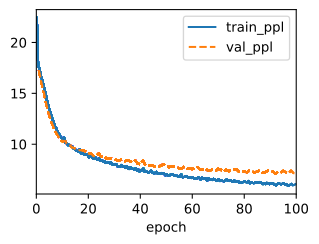
with d2l.try_gpu():
    trainer = d2l.Trainer(max_epochs=100, gradient_clip_val=1)
trainer.fit(model, data)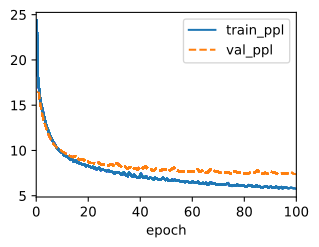
trainer = d2l.Trainer(max_epochs=100, gradient_clip_val=1, num_gpus=1)
trainer.fit(model, data)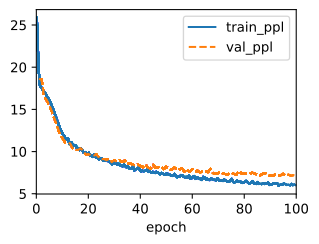
Compared with Section 9.5, this model achieves comparable perplexity, but runs faster due to the optimized implementations. As before, we can generate predicted tokens following the specified prefix string.
model.predict('it has', 20, data.vocab, d2l.try_gpu())'it has a monstoun and the 'model.predict('it has', 20, data.vocab)'it has thoun said the thin'model.predict('it has', 20, data.vocab, d2l.try_gpu())'it has the the this the th'9.6.3 Summary
High-level APIs in deep learning frameworks provide implementations of standard RNNs. These libraries help you to avoid wasting time reimplementing standard models. Moreover, framework implementations are often highly optimized, leading to significant (computational) performance gains when compared with implementations from scratch.
9.6.4 Exercises
- Can you make the RNN model overfit using the high-level APIs?
- Implement the autoregressive model of Section 9.1 using an RNN.