from d2l import torch as d2l
import torch4.4 Softmax Regression Implementation from Scratch
Because softmax regression is so fundamental, we believe that you ought to know how to implement it yourself. Here, we limit ourselves to defining the softmax-specific aspects of the model and reuse the other components from our linear regression section, including the training loop.
from d2l import tensorflow as d2l
import tensorflow as tf
from d2l import jax as d2l
from flax import linen as nn
import jax
from jax import numpy as jnp
from functools import partialfrom d2l import mxnet as d2l
from mxnet import autograd, np, npx, gluon
npx.set_np()4.4.1 The Softmax
Let’s begin with the most important part: the mapping from scalars to probabilities. For a refresher, recall the operation of the sum operator along specific dimensions in a tensor, as discussed in Section 2.3.6 and Section 2.3.7. Given a matrix X we can sum over all elements (by default) or only over elements in the same axis. The axis variable lets us compute row and column sums:
X = d2l.tensor([[1.0, 2.0, 3.0], [4.0, 5.0, 6.0]])
d2l.reduce_sum(X, 0, keepdims=True), d2l.reduce_sum(X, 1, keepdims=True)(tensor([[5., 7., 9.]]),
tensor([[ 6.],
[15.]]))(<tf.Tensor: shape=(1, 3), dtype=float32, numpy=array([[5., 7., 9.]], dtype=float32)>,
<tf.Tensor: shape=(2, 1), dtype=float32, numpy=
array([[ 6.],
[15.]], dtype=float32)>)(Array([[5., 7., 9.]], dtype=float32),
Array([[ 6.],
[15.]], dtype=float32))(array([[5., 7., 9.]]),
array([[ 6.],
[15.]]))Computing the softmax requires three steps: (i) exponentiation of each term; (ii) a sum over each row to compute the normalization constant for each example; (iii) division of each row by its normalization constant, ensuring that the result sums to 1:
\[\mathrm{softmax}(\mathbf{X})_{ij} = \frac{\exp(\mathbf{X}_{ij})}{\sum_k \exp(\mathbf{X}_{ik})}. \tag{4.4.1}\]
The (logarithm of the) denominator is called the (log) partition function. It was introduced in statistical physics to sum over all possible states in a thermodynamic ensemble. The implementation is straightforward:
def softmax(X):
    X_exp = d2l.exp(X)
    partition = d2l.reduce_sum(X_exp, 1, keepdims=True)
    return X_exp / partition  # The broadcasting mechanism is applied here
For any input X, we turn each element into a nonnegative number. Each row sums up to 1, as is required for a probability. Caution: the code above is not robust against very large or very small arguments. While it is sufficient to illustrate what is happening, you should not use this code verbatim for any serious purpose. Deep learning frameworks have such protections built in and we will be using the built-in softmax going forward.
X = d2l.rand((2, 5))
X_prob = softmax(X)
X_prob, d2l.reduce_sum(X_prob, 1)
(tensor([[0.1932, 0.2324, 0.1265, 0.1934, 0.2546],
[0.1769, 0.2676, 0.2368, 0.1560, 0.1627]]),
tensor([1.0000, 1.0000]))X = d2l.rand((2, 5))
X_prob = softmax(X)
X_prob, d2l.reduce_sum(X_prob, 1)(<tf.Tensor: shape=(2, 5), dtype=float32, numpy=
array([[0.19942124, 0.14203437, 0.15942493, 0.35249642, 0.14662308],
[0.16552942, 0.30346 , 0.16671702, 0.16054861, 0.20374495]],
dtype=float32)>,
<tf.Tensor: shape=(2,), dtype=float32, numpy=array([1., 1.], dtype=float32)>)X = jax.random.uniform(jax.random.PRNGKey(d2l.get_seed()), (2, 5))
X_prob = softmax(X)
X_prob, d2l.reduce_sum(X_prob, 1)(Array([[0.14968221, 0.1875777 , 0.23609626, 0.19109097, 0.23555289],
[0.2636405 , 0.17738865, 0.20456591, 0.16327971, 0.19112521]], dtype=float32),
Array([1., 1.], dtype=float32))X = d2l.rand(2, 5)
X_prob = softmax(X)
X_prob, d2l.reduce_sum(X_prob, 1)(array([[0.17777154, 0.1857739 , 0.20995119, 0.23887765, 0.18762572],
[0.24042214, 0.1757977 , 0.23786479, 0.15572716, 0.19018826]]),
array([1., 1.]))4.4.2 The Model
We now have everything that we need to implement the softmax regression model. As in our linear regression example, each instance will be represented by a fixed-length vector. Since the raw data here consists of \(28 \times 28\) pixel images, we flatten each image, treating them as vectors of length 784. In later chapters, we will introduce convolutional neural networks, which exploit the spatial structure in a more satisfying way.
In softmax regression, the number of outputs from our network should be equal to the number of classes. Since our dataset has 10 classes, our network has an output dimension of 10. Consequently, our weights constitute a \(784 \times 10\) matrix plus a \(1 \times 10\) row vector for the biases. As with linear regression, we initialize the weights W with Gaussian noise. The biases are initialized as zeros.
class SoftmaxRegressionScratch(d2l.Classifier):
    def __init__(self, num_inputs, num_outputs, lr, sigma=0.01):
        super().__init__()
        self.save_hyperparameters()
        self.W = torch.normal(0, sigma, size=(num_inputs, num_outputs),
                              requires_grad=True)
        self.b = torch.zeros(num_outputs, requires_grad=True)

    def parameters(self):
        return [self.W, self.b]
class SoftmaxRegressionScratch(d2l.Classifier):
def __init__(self, num_inputs, num_outputs, lr, sigma=0.01):
super().__init__()
self.save_hyperparameters()
self.W = tf.random.normal((num_inputs, num_outputs), 0, sigma)
self.b = tf.zeros(num_outputs)
self.W = tf.Variable(self.W)
self.b = tf.Variable(self.b)class SoftmaxRegressionScratch(d2l.Classifier):
num_inputs: int
num_outputs: int
lr: float
sigma: float = 0.01
def setup(self):
self.W = self.param('W', nn.initializers.normal(self.sigma),
(self.num_inputs, self.num_outputs))
self.b = self.param('b', nn.initializers.zeros, self.num_outputs)class SoftmaxRegressionScratch(d2l.Classifier):
def __init__(self, num_inputs, num_outputs, lr, sigma=0.01):
super().__init__()
self.save_hyperparameters()
self.W = np.random.normal(0, sigma, (num_inputs, num_outputs))
self.b = np.zeros(num_outputs)
self.W.attach_grad()
self.b.attach_grad()
def collect_params(self):
return [self.W, self.b]The code below defines how the network maps each input to an output. Note that we flatten each \(28 \times 28\) pixel image in the batch into a vector using reshape before passing the data through our model.
@d2l.add_to_class(SoftmaxRegressionScratch)
def forward(self, X):
    X = d2l.reshape(X, (-1, self.W.shape[0]))
    return softmax(d2l.matmul(X, self.W) + self.b)
4.4.3 The Cross-Entropy Loss
Next we need to implement the cross-entropy loss function (introduced in Section 4.1.2). This may be the most common loss function in all of deep learning. At the moment, applications of deep learning easily cast as classification problems far outnumber those better treated as regression problems.
Recall that cross-entropy takes the negative log-likelihood of the predicted probability assigned to the true label. For efficiency we avoid Python for-loops and use indexing instead. In particular, the one-hot encoding in \(\mathbf{y}\) allows us to select the matching terms in \(\hat{\mathbf{y}}\).
To see this in action we create sample data y_hat with 2 examples of predicted probabilities over 3 classes and their corresponding labels y. The correct labels are \(0\) and \(2\) respectively (i.e., the first and third class). Using y as the indices of the probabilities in y_hat, we can pick out terms efficiently.
y = d2l.tensor([0, 2])
y_hat = d2l.tensor([[0.1, 0.3, 0.6], [0.3, 0.2, 0.5]])
y_hat[[0, 1], y]
tensor([0.1000, 0.5000])y_hat = tf.constant([[0.1, 0.3, 0.6], [0.3, 0.2, 0.5]])
y = tf.constant([0, 2])
tf.boolean_mask(y_hat, tf.one_hot(y, depth=y_hat.shape[-1]))<tf.Tensor: shape=(2,), dtype=float32, numpy=array([0.1, 0.5], dtype=float32)>y = d2l.tensor([0, 2])
y_hat = d2l.tensor([[0.1, 0.3, 0.6], [0.3, 0.2, 0.5]])
y_hat[[0, 1], y]Array([0.1, 0.5], dtype=float32)y = d2l.tensor([0, 2])
y_hat = d2l.tensor([[0.1, 0.3, 0.6], [0.3, 0.2, 0.5]])
y_hat[[0, 1], y]array([0.1, 0.5])Now we can implement the cross-entropy loss function by averaging over the logarithms of the selected probabilities.
Now we can implement the cross-entropy loss function by averaging over the logarithms of the selected probabilities.
Now we can implement the cross-entropy loss function by averaging over the logarithms of the selected probabilities.
Note that to make use of jax.jit to speed up JAX implementations, and to make sure loss is a pure function, the cross_entropy function is re-defined inside the loss to avoid usage of any global variables or functions which may render the loss function impure. We refer interested readers to the JAX documentation on jax.jit and pure functions.
Now we can implement the cross-entropy loss function by averaging over the logarithms of the selected probabilities.
def cross_entropy(y_hat, y):
    return -d2l.reduce_mean(d2l.log(y_hat[list(range(len(y_hat))), y]))

cross_entropy(y_hat, y)tensor(1.4979)def cross_entropy(y_hat, y):
return -tf.reduce_mean(tf.math.log(tf.boolean_mask(
y_hat, tf.one_hot(y, depth=y_hat.shape[-1]))))
cross_entropy(y_hat, y)<tf.Tensor: shape=(), dtype=float32, numpy=1.497866153717041>def cross_entropy(y_hat, y):
return -d2l.reduce_mean(d2l.log(y_hat[list(range(len(y_hat))), y]))
cross_entropy(y_hat, y)Array(1.4978662, dtype=float32)def cross_entropy(y_hat, y):
return -d2l.reduce_mean(d2l.log(y_hat[list(range(len(y_hat))), y]))
cross_entropy(y_hat, y)array(1.4978662)@d2l.add_to_class(SoftmaxRegressionScratch)
def loss(self, y_hat, y):
return cross_entropy(y_hat, y)@d2l.add_to_class(SoftmaxRegressionScratch)
def loss(self, y_hat, y):
return cross_entropy(y_hat, y)@d2l.add_to_class(SoftmaxRegressionScratch)
@partial(jax.jit, static_argnums=(0))
def loss(self, params, X, y, state):
def cross_entropy(y_hat, y):
return -d2l.reduce_mean(d2l.log(y_hat[list(range(len(y_hat))), y]))
y_hat = state.apply_fn({'params': params}, *X)
# The returned empty dictionary is a placeholder for auxiliary data,
# which will be used later (e.g., for batch norm)
return cross_entropy(y_hat, y), {}@d2l.add_to_class(SoftmaxRegressionScratch)
def loss(self, y_hat, y):
return cross_entropy(y_hat, y)4.4.4 Training
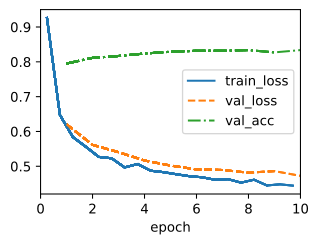
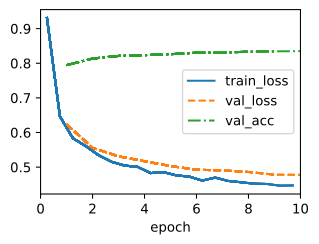
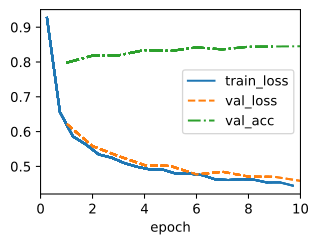
We reuse the fit method defined in Section 3.4 to train the model with 10 epochs. Note that the number of epochs (max_epochs), the minibatch size (batch_size), and learning rate (lr) are adjustable hyperparameters. That means that while these values are not learned during our primary training loop, they still influence the performance of our model, both vis-à-vis training and generalization performance. In practice you will want to choose these values based on the validation split of the data and then, ultimately, to evaluate your final model on the test split. As discussed in Section 3.6.3, we will regard the test data of Fashion-MNIST as the validation set, thus reporting validation loss and validation accuracy on this split.
data = d2l.FashionMNIST(batch_size=256)
model = SoftmaxRegressionScratch(num_inputs=784, num_outputs=10, lr=0.1)
trainer = d2l.Trainer(max_epochs=10)
trainer.fit(model, data)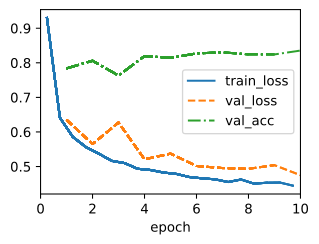
4.4.5 Prediction
Now that training is complete, our model is ready to classify some images.
X, y = next(iter(data.val_dataloader()))
preds = d2l.argmax(model(X), axis=1)
preds.shapetorch.Size([256])X, y = next(iter(data.val_dataloader()))
preds = d2l.argmax(model(X), axis=1)
preds.shapeTensorShape([256])X, y = next(iter(data.val_dataloader()))
preds = d2l.argmax(model.apply({'params': trainer.state.params}, X), axis=1)
preds.shape(256,)X, y = next(iter(data.val_dataloader()))
preds = d2l.argmax(model(X), axis=1)
preds.shape(256,)We are more interested in the images we label incorrectly. We visualize them by comparing their actual labels (first line of text output) with the predictions from the model (second line of text output).
wrong = d2l.astype(preds, y.dtype) != y
X, y, preds = X[wrong], y[wrong], preds[wrong]
labels = [a+'\n'+b for a, b in zip(
    data.text_labels(y), data.text_labels(preds))]
data.visualize([X, y], labels=labels)



4.4.6 Summary
By now we are starting to get some experience with solving linear regression and classification problems. With it, we have reached what would arguably be the state of the art of 1960–1970s of statistical modeling. In the next section, we will show you how to leverage deep learning frameworks to implement this model much more efficiently.
4.4.7 Exercises
- In this section, we directly implemented the softmax function based on the mathematical definition of the softmax operation. As discussed in Section 4.1 this can cause numerical instabilities.
- Test whether
softmaxstill works correctly if an input has a value of \(100\). - Test whether
softmaxstill works correctly if the largest of all inputs is smaller than \(-100\). - Implement a fix by looking at the value relative to the largest entry in the argument.
- Test whether
- Implement a
cross_entropyfunction that follows the definition of the cross-entropy loss function \(\sum_i y_i \log \hat{y}_i\).- Try it out in the code example of this section.
- Why do you think it runs more slowly?
- Should you use it? When would it make sense to?
- What do you need to be careful of? Hint: consider the domain of the logarithm.
- Is it always a good idea to return the most likely label? For example, would you do this for medical diagnosis? How would you try to address this?
- Assume that we want to use softmax regression to predict the next word based on some features. What are some problems that might arise from a large vocabulary?
- Experiment with the hyperparameters of the code in this section. In particular:
- Plot how the validation loss changes as you change the learning rate.
- Do the validation and training loss change as you change the minibatch size? How large or small do you need to go before you see an effect?