from d2l import torch as d2l
import torch
import math12.8 RMSProp
One of the key issues in Section 12.7 is that the learning rate decreases at a predefined schedule of effectively \(\mathcal{O}(t^{-\frac{1}{2}})\). While this is generally appropriate for convex problems, it might not be ideal for nonconvex ones, such as those encountered in deep learning. Yet, the coordinate-wise adaptivity of Adagrad is highly desirable as a preconditioner.
Tieleman and Hinton (2012) proposed the RMSProp algorithm as a simple fix to decouple rate scheduling from coordinate-adaptive learning rates. The issue is that Adagrad accumulates the squares of the gradient \(\mathbf{g}_t\) into a state vector \(\mathbf{s}_t = \mathbf{s}_{t-1} + \mathbf{g}_t^2\). As a result \(\mathbf{s}_t\) keeps on growing without bound due to the lack of normalization, essentially linearly as the algorithm converges.
One way of fixing this problem would be to use \(\mathbf{s}_t / t\). For reasonable distributions of \(\mathbf{g}_t\) this will converge. Unfortunately it might take a very long time until the limit behavior starts to matter since the procedure remembers the full trajectory of values. An alternative is to use a leaky average in the same way we used in the momentum method, i.e., \(\mathbf{s}_t \leftarrow \gamma \mathbf{s}_{t-1} + (1-\gamma) \mathbf{g}_t^2\) for some parameter \(\gamma > 0\). Keeping all other parts unchanged yields RMSProp.
12.8.1 The Algorithm
Let’s write out the equations in detail.
\[\begin{aligned} \mathbf{s}_t & \leftarrow \gamma \mathbf{s}_{t-1} + (1 - \gamma) \mathbf{g}_t^2, \\ \mathbf{x}_t & \leftarrow \mathbf{x}_{t-1} - \frac{\eta}{\sqrt{\mathbf{s}_t + \epsilon}} \odot \mathbf{g}_t. \end{aligned} \tag{12.8.1}\]
The constant \(\epsilon > 0\) is typically set to \(10^{-6}\) to ensure that we do not suffer from division by zero or overly large step sizes. Given this expansion we are now free to control the learning rate \(\eta\) independently of the scaling that is applied on a per-coordinate basis. In terms of leaky averages we can apply the same reasoning as previously applied in the case of the momentum method. Expanding the definition of \(\mathbf{s}_t\) yields
\[ \begin{aligned} \mathbf{s}_t & = (1 - \gamma) \mathbf{g}_t^2 + \gamma \mathbf{s}_{t-1} \\ & = (1 - \gamma) \left(\mathbf{g}_t^2 + \gamma \mathbf{g}_{t-1}^2 + \gamma^2 \mathbf{g}_{t-2} + \ldots, \right). \end{aligned} \]
As before in Section 12.6 we use \(1 + \gamma + \gamma^2 + \ldots, = \frac{1}{1-\gamma}\). Hence the sum of weights is normalized to \(1\) with a half-life time of an observation of \(\gamma^{-1}\). Let’s visualize the weights for the past 40 time steps for various choices of \(\gamma\).
from d2l import tensorflow as d2l
import tensorflow as tf
import math
from d2l import jax as d2l
import jax
from jax import numpy as jnp
import math
import numpy as np%matplotlib inline
from d2l import mxnet as d2l
import math
from mxnet import np, npx
npx.set_np()d2l.set_figsize()
gammas = [0.95, 0.9, 0.8, 0.7]
for gamma in gammas:
x = d2l.numpy(d2l.arange(40))
d2l.plt.plot(x, (1-gamma) * gamma ** x, label=f'gamma = {gamma:.2f}')
d2l.plt.xlabel('time');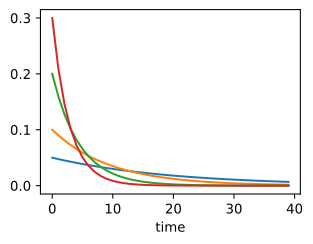
12.8.2 Implementation from Scratch
As before we use the quadratic function \(f(\mathbf{x})=0.1x_1^2+2x_2^2\) to observe the trajectory of RMSProp. Recall that in Section 12.7, when we used Adagrad with a learning rate of 0.4, the variables moved only very slowly in the later stages of the algorithm since the learning rate decreased too quickly. Since \(\eta\) is controlled separately this does not happen with RMSProp.
def rmsprop_2d(x1, x2, s1, s2):
    g1, g2, eps = 0.2 * x1, 4 * x2, 1e-6
    s1 = gamma * s1 + (1 - gamma) * g1 ** 2
    s2 = gamma * s2 + (1 - gamma) * g2 ** 2
    x1 -= eta / math.sqrt(s1 + eps) * g1
    x2 -= eta / math.sqrt(s2 + eps) * g2
    return x1, x2, s1, s2

def f_2d(x1, x2):
    return 0.1 * x1 ** 2 + 2 * x2 ** 2

eta, gamma = 0.4, 0.9
d2l.show_trace_2d(f_2d, d2l.train_2d(rmsprop_2d))epoch 20, x1: -0.010599, x2: 0.000000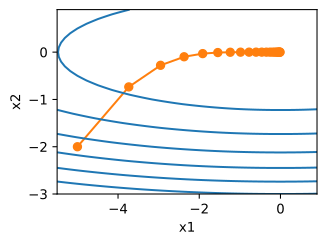
epoch 20, x1: -0.010599, x2: 0.000000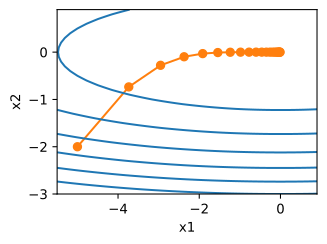
epoch 20, x1: -0.010599, x2: 0.000000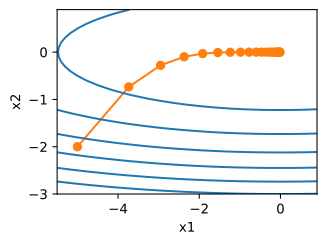
epoch 20, x1: -0.010599, x2: 0.000000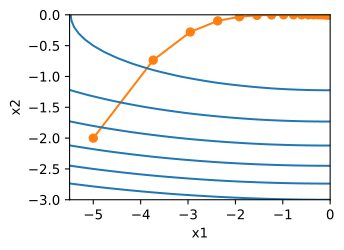
Next, we implement RMSProp to be used in a deep network. This is equally straightforward.
def init_rmsprop_states(feature_dim):
    s_w = d2l.zeros((feature_dim, 1))
    s_b = d2l.zeros(1)
    return (s_w, s_b)
def init_rmsprop_states(feature_dim):
s_w = tf.Variable(d2l.zeros((feature_dim, 1)))
s_b = tf.Variable(d2l.zeros(1))
return (s_w, s_b)def init_rmsprop_states(feature_dim):
s_w = jnp.zeros((feature_dim, 1))
s_b = jnp.zeros(1)
return [s_w, s_b]def init_rmsprop_states(feature_dim):
s_w = d2l.zeros((feature_dim, 1))
s_b = d2l.zeros(1)
return (s_w, s_b)def rmsprop(params, states, hyperparams):
gamma, eps = hyperparams['gamma'], 1e-6
for p, s in zip(params, states):
with torch.no_grad():
s[:] = gamma * s + (1 - gamma) * torch.square(p.grad)
p[:] -= hyperparams['lr'] * p.grad / torch.sqrt(s + eps)
p.grad.data.zero_()def rmsprop(params, grads, states, hyperparams):
gamma, eps = hyperparams['gamma'], 1e-6
for p, s, g in zip(params, states, grads):
s[:].assign(gamma * s + (1 - gamma) * tf.math.square(g))
p[:].assign(p - hyperparams['lr'] * g / tf.math.sqrt(s + eps))def rmsprop(params, grads, states, hyperparams):
gamma, eps = hyperparams['gamma'], 1e-6
for i, (p, s, g) in enumerate(zip(params, states, grads)):
s = gamma * s + (1 - gamma) * jnp.square(g)
params[i] = p - hyperparams['lr'] * g / jnp.sqrt(s + eps)
states[i] = s
return params[0], params[1]def rmsprop(params, states, hyperparams):
gamma, eps = hyperparams['gamma'], 1e-6
for p, s in zip(params, states):
s[:] = gamma * s + (1 - gamma) * np.square(p.grad)
p[:] -= hyperparams['lr'] * p.grad / np.sqrt(s + eps)We set the initial learning rate to 0.01 and the weighting term \(\gamma\) to 0.9. That is, \(\mathbf{s}\) aggregates on average over the past \(1/(1-\gamma) = 10\) observations of the square gradient.
data_iter, feature_dim = d2l.get_data_ch11(batch_size=10)
d2l.train_ch11(rmsprop, init_rmsprop_states(feature_dim),
{'lr': 0.01, 'gamma': 0.9}, data_iter, feature_dim);loss: 0.246, 0.113 sec/epoch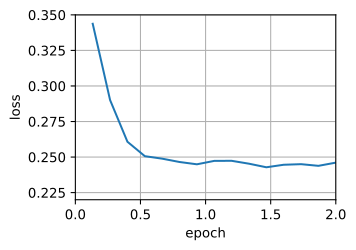
loss: 0.246, 1.199 sec/epoch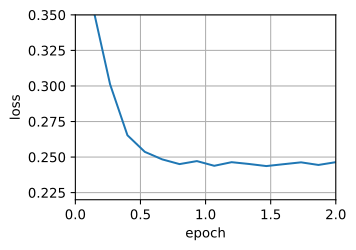
loss: 0.243, 2.586 sec/epoch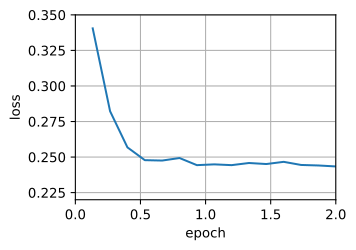
loss: 0.247, 0.688 sec/epoch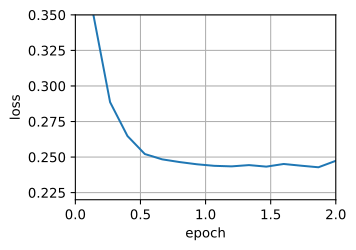
12.8.3 Concise Implementation
Since RMSProp is a rather popular algorithm it is also available in the Trainer instance. All we need to do is instantiate it using an algorithm named rmsprop, assigning \(\gamma\) to the parameter gamma1.
trainer = torch.optim.RMSprop
d2l.train_concise_ch11(trainer, {'lr': 0.01, 'alpha': 0.9},
                       data_iter)
loss: 0.243, 0.075 sec/epoch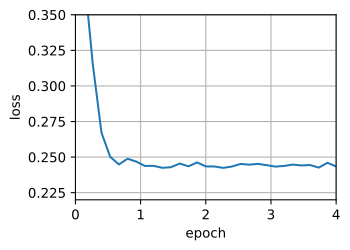
trainer = tf.keras.optimizers.RMSprop
d2l.train_concise_ch11(trainer, {'learning_rate': 0.01, 'rho': 0.9},
                       data_iter)
loss: 0.243, 1.378 sec/epoch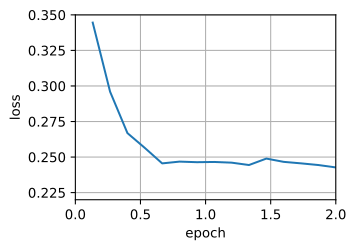
import optax
trainer = optax.rmsprop
d2l.train_concise_ch11(trainer, {'learning_rate': 0.01, 'decay': 0.9},
                       data_iter)
loss: 0.247, 2.483 sec/epoch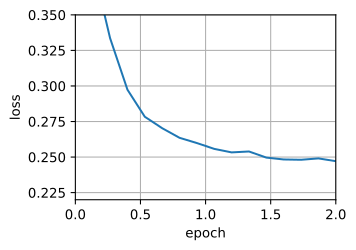
d2l.train_concise_ch11('rmsprop', {'learning_rate': 0.01, 'gamma1': 0.9},
                       data_iter)
loss: 0.243, 0.408 sec/epoch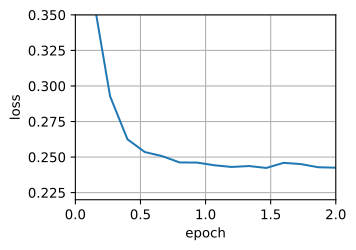
12.8.4 Summary
- RMSProp is very similar to Adagrad insofar as both use the square of the gradient to scale coefficients.
- RMSProp shares with momentum the leaky averaging. However, RMSProp uses the technique to adjust the coefficient-wise preconditioner.
- The learning rate needs to be scheduled by the experimenter in practice.
- The coefficient \(\gamma\) determines how long the history is when adjusting the per-coordinate scale.
12.8.5 Exercises
- What happens experimentally if we set \(\gamma = 1\)? Why?
- Rotate the optimization problem to minimize \(f(\mathbf{x}) = 0.1 (x_1 + x_2)^2 + 2 (x_1 - x_2)^2\). What happens to the convergence?
- Try out what happens to RMSProp on a real machine learning problem, such as training on Fashion-MNIST. Experiment with different choices for adjusting the learning rate.
- Would you want to adjust \(\gamma\) as optimization progresses? How sensitive is RMSProp to this?