from d2l import torch as d2l
import numpy as np
import torch
from torch import nn
from scipy import stats19.1 What Is Hyperparameter Optimization?
As we have seen in the previous chapters, deep neural networks come with a large number of parameters or weights that are learned during training. On top of these, every neural network has additional hyperparameters that need to be configured by the user. For example, to ensure that stochastic gradient descent converges to a local optimum of the training loss (see Chapter 12), we have to adjust the learning rate and batch size. To avoid overfitting on the training dataset, we might have to set regularization parameters, such as weight decay (see Section 3.7) or dropout (see Section 5.6). We can define the capacity and inductive bias of the model by setting the number of layers and number of units or filters per layer (i.e., the effective number of weights).
Unfortunately, we cannot simply adjust these hyperparameters by minimizing the training loss, because this would lead to overfitting on the training data. For example, setting regularization parameters, such as dropout or weight decay to zero leads to a small training loss, but might hurt the generalization performance.
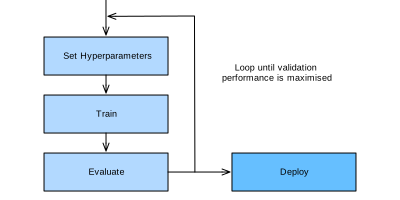
Without a different form of automation, hyperparameters have to be set manually in a trial-and-error fashion, in what amounts to a time-consuming and difficult part of machine learning workflows. For example, consider training a ResNet (see Section 8.6) on CIFAR-10, which requires more than 2 hours on an Amazon Elastic Cloud Compute (EC2) g4dn.xlarge instance. Even just trying ten hyperparameter configurations in sequence would already take us roughly one day. To make matters worse, hyperparameters are usually not directly transferable across architectures and datasets (Feurer et al. 2022; Wistuba et al. 2018; Bardenet et al. 2013), and need to be re-optimized for every new task. Also, for most hyperparameters, there are no rule-of-thumbs, and expert knowledge is required to find sensible values.
Hyperparameter optimization (HPO) algorithms are designed to tackle this problem in a principled and automated fashion (Feurer and Hutter 2019), by framing it as a global optimization problem. The default objective is the error on a hold-out validation dataset, but could in principle be any other business metric. It can be combined with or constrained by secondary objectives, such as training time, inference time, or model complexity.
Recently, hyperparameter optimization has been extended to neural architecture search (NAS) (Elsken et al. 2018; Wistuba et al. 2019), where the goal is to find entirely new neural network architectures. Compared to classical HPO, NAS is even more expensive in terms of computation and requires additional efforts to remain feasible in practice. Both, HPO and NAS can be considered as sub-fields of AutoML (Hutter et al. 2019), which aims to automate the entire ML pipeline.
In this section we will introduce HPO and show how we can automatically find the best hyperparameters of the logistic regression example introduced in Section 4.5.
19.1.1 The Optimization Problem
We will start with a simple toy problem: searching for the learning rate of the multi-class logistic regression model SoftmaxRegression from Section 4.5 to minimize the validation error on the Fashion MNIST dataset. While other hyperparameters like batch size or number of epochs are also worth tuning, we focus on learning rate alone for simplicity.
from d2l import jax as d2l
import jax
from jax import numpy as jnp
from flax import linen as nn
import optax
import numpy as np
from scipy import stats
Before we can run HPO, we first need to define two ingredients: the objective function and the configuration space.
19.1.1.1 The Objective Function
The performance of a learning algorithm can be seen as a function \(f: \mathcal{X} \rightarrow \mathbb{R}\) that maps from the hyperparameter space \(\mathbf{x} \in \mathcal{X}\) to the validation loss. For every evaluation of \(f(\mathbf{x})\), we have to train and validate our machine learning model, which can be time and compute intensive in the case of deep neural networks trained on large datasets. Given our criterion \(f(\mathbf{x})\) our goal is to find \(\mathbf{x}_{\star} \in \mathrm{argmin}_{\mathbf{x} \in \mathcal{X}} f(\mathbf{x})\).
There is no simple way to compute gradients of \(f\) with respect to \(\mathbf{x}\), because it would require propagating the gradient through the entire training process. While there is recent work (Maclaurin et al. 2015; Franceschi et al. 2017) to drive HPO by approximate “hypergradients”, none of the existing approaches are competitive with the state-of-the-art yet, and we will not discuss them here. Furthermore, the computational burden of evaluating \(f\) requires HPO algorithms to approach the global optimum with as few samples as possible.
The training of neural networks is stochastic (e.g., weights are randomly initialized, mini-batches are randomly sampled), so that our observations will be noisy: \(y \sim f(\mathbf{x}) + \epsilon\), where we usually assume that the \(\epsilon \sim N(0, \sigma)\) observation noise is Gaussian distributed.
Faced with all these challenges, we usually try to identify a small set of well performing hyperparameter configurations quickly, instead of hitting the global optima exactly. However, due to large computational demands of most neural network models, even this can take days or weeks of compute. We will explore in Section 19.4 how we can speed-up the optimization process by either distributing the search or using cheaper-to-evaluate approximations of the objective function.
We begin with a method for computing the validation error of a model.
class HPOTrainer(d2l.Trainer):
    def validation_error(self):
        self.model.eval()
        accuracy = 0
        val_batch_idx = 0
        for batch in self.val_dataloader:
            with torch.no_grad():
                x, y = self.prepare_batch(batch)
                y_hat = self.model(x)
                accuracy += self.model.accuracy(y_hat, y)
            val_batch_idx += 1
        return 1 -  accuracy / val_batch_idx
class HPOTrainer(d2l.Trainer):
def validation_error(self):
self.model.training = False
accuracy = 0
val_batch_idx = 0
for batch in self.val_dataloader:
batch = self.prepare_batch(batch)
accuracy += self.model.accuracy(
self.state.params, batch[:-1], batch[-1], self.state)
val_batch_idx += 1
return 1 - accuracy / val_batch_idxWe optimize validation error with respect to the hyperparameter configuration config, consisting of the learning_rate. For each evaluation, we train our model for max_epochs epochs, then compute and return its validation error:
def hpo_objective_softmax_classification(config, max_epochs=8):
    learning_rate = config["learning_rate"]
    trainer = d2l.HPOTrainer(max_epochs=max_epochs)
    data = d2l.FashionMNIST(batch_size=16)
    model = d2l.SoftmaxRegression(num_outputs=10, lr=learning_rate)
    trainer.fit(model=model, data=data)
    return d2l.numpy(trainer.validation_error())
def hpo_objective_softmax_classification(config, max_epochs=8):
learning_rate = config["learning_rate"]
trainer = d2l.HPOTrainer(max_epochs=max_epochs)
data = d2l.FashionMNIST(batch_size=16)
model = d2l.SoftmaxRegression(num_outputs=10, lr=learning_rate)
trainer.fit(model=model, data=data)
return float(trainer.validation_error())19.1.1.2 The Configuration Space
Along with the objective function \(f(\mathbf{x})\), we also need to define the feasible set \(\mathbf{x} \in \mathcal{X}\) to optimize over, known as configuration space or search space. For our logistic regression example, we will use:
config_space = {"learning_rate": stats.loguniform(1e-4, 1)}Here we use the loguniform object from SciPy, which represents a uniform distribution between -4 and -1 in the logarithmic space. This object allows us to sample random variables from this distribution.
Each hyperparameter has a data type, such as float for learning_rate, as well as a closed bounded range (i.e., lower and upper bounds). We usually assign a prior distribution (e.g, uniform or log-uniform) to each hyperparameter to sample from. Some positive parameters, such as learning_rate, are best represented on a logarithmic scale as optimal values can differ by several orders of magnitude, while others, such as momentum, come with linear scale.
Below we show a simple example of a configuration space consisting of typical hyperparameters of a multi-layer perceptron including their type and standard ranges.
| Name | Type | Hyperparameter Ranges | log-scale |
|---|---|---|---|
| learning rate | float | \([10^{-6},10^{-1}]\) | yes |
| batch size | integer | \([8,256]\) | yes |
| momentum | float | \([0,0.99]\) | no |
| activation function | categorical | \(\{\textrm{tanh}, \textrm{relu}\}\) | - |
| number of units | integer | \([32, 1024]\) | yes |
| number of layers | integer | \([1, 6]\) | no |
In general, the structure of the configuration space \(\mathcal{X}\) can be complex and it can be quite different from \(\mathbb{R}^d\). In practice, some hyperparameters may depend on the value of others. For example, assume we try to tune the number of layers for a multi-layer perceptron, and for each layer the number of units. The number of units of the \(l\textrm{-th}\) layer is relevant only if the network has at least \(l+1\) layers. These advanced HPO problems are beyond the scope of this chapter. We refer the interested reader to (Hutter et al. 2011; Jenatton et al. 2017; Baptista and Poloczek 2018).
The configuration space plays an important role for hyperparameter optimization, since no algorithms can find something that is not included in the configuration space. On the other hand, if the ranges are too large, the computation budget to find well performing configurations might become infeasible.
19.1.2 Random Search
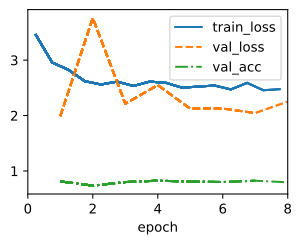
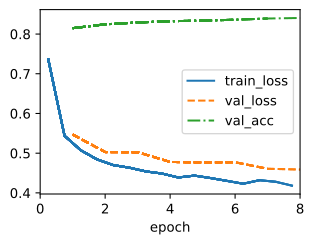
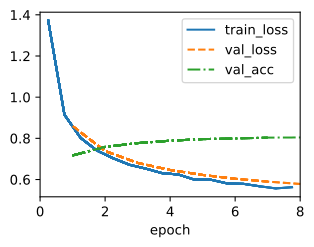
Random search (Bergstra and Bengio 2012) is the first hyperparameter optimization algorithm we will consider. The main idea of random search is to independently sample from the configuration space until a predefined budget (e.g maximum number of iterations) is exhausted, and to return the best observed configuration. All evaluations can be executed independently in parallel (see Section 19.3), but here we use a sequential loop for simplicity.
errors, values = [], []
num_iterations = 5

for i in range(num_iterations):
    learning_rate = config_space["learning_rate"].rvs()
    print(f"Trial {i}: learning_rate = {learning_rate}")
    y = hpo_objective_softmax_classification({"learning_rate": learning_rate})
    print(f"    validation_error = {y}")
    values.append(learning_rate)
errors.append(y) validation_error = 0.1784999966621399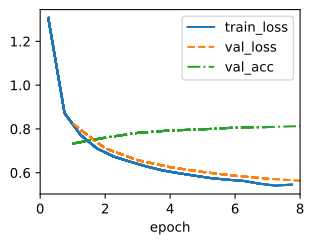
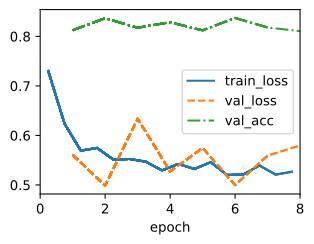
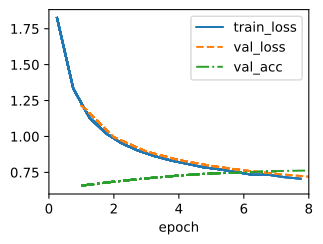
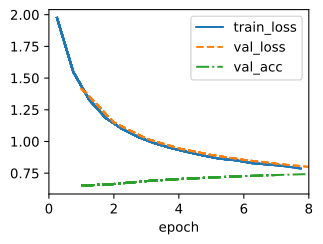
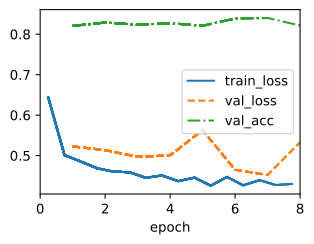
validation_error = 0.19579994678497314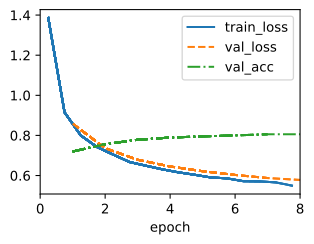
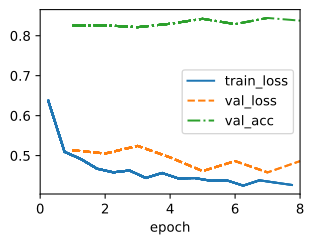
The best learning rate is then simply the one with the lowest validation error.
best_idx = np.argmin(errors)
print(f"optimal learning rate = {values[best_idx]}")optimal learning rate = 0.061400132828546415optimal learning rate = 0.018083742342312442Due to its simplicity and generality, random search is one of the most frequently used HPO algorithms. It does not require any sophisticated implementation and can be applied to any configuration space as long as we can define some probability distribution for each hyperparameter.
Unfortunately random search also comes with a few shortcomings. First, it does not adapt the sampling distribution based on the previous observations it collected so far. Hence, it is equally likely to sample a poorly performing configuration than a better performing configuration. Second, the same amount of resources are spent for all configurations, even though some may show poor initial performance and are less likely to outperform previously seen configurations.
In the next sections we will look at more sample efficient hyperparameter optimization algorithms that overcome the shortcomings of random search by using a model to guide the search. We will also look at algorithms that automatically stop the evaluation process of poorly performing configurations to speed up the optimization process.
19.1.3 Summary
In this section we introduced hyperparameter optimization (HPO) and how we can phrase it as a global optimization by defining a configuration space and an objective function. We also implemented our first HPO algorithm, random search, and applied it on a simple softmax classification problem.
While random search is very simple, it is the better alternative to grid search, which simply evaluates a fixed set of hyperparameters. Random search somewhat mitigates the curse of dimensionality (Bellman 1966), and can be far more efficient than grid search if the criterion most strongly depends on a small subset of the hyperparameters (Bergstra and Bengio 2012).
19.1.4 Exercises
- In this chapter, we optimize the validation error of a model after training on a disjoint training set. For simplicity, our code uses
Trainer.val_dataloader, which maps to a loader aroundFashionMNIST.val.- Convince yourself (by looking at the code) that this means we use the original FashionMNIST training set (60000 examples) for training, and the original test set (10000 examples) for validation.
- Why could this practice be problematic? Hint: Re-read Section 3.6, especially about model selection.
- What should we have done instead?
- We stated above that hyperparameter optimization by gradient descent is very hard to do. Consider a small problem, such as training a two-layer perceptron on the FashionMNIST dataset (Section 5.2) with a batch size of 256. We would like to tune the learning rate of SGD in order to minimize a validation metric after one epoch of training.
- Why cannot we use validation error for this purpose? What metric on the validation set would you use?
- Sketch (roughly) the computational graph of the validation metric after training for one epoch. You may assume that initial weights and hyperparameters (such as learning rate) are input nodes to this graph. Hint: Re-read about computational graphs in Section 5.3.
- Give a rough estimate of the number of floating point values you need to store during a forward pass on this graph. Hint: FashionMNIST has 60000 cases. Assume the required memory is dominated by the activations after each layer, and look up the layer widths in Section 5.2.
- Apart from the sheer amount of compute and storage required, what other issues would gradient-based hyperparameter optimization run into? Hint: Re-read about vanishing and exploding gradients in Section 5.4.
- Advanced: Read (Maclaurin et al. 2015) for an elegant (yet still somewhat unpractical) approach to gradient-based HPO.
- Grid search is another HPO baseline, where we define an equispaced grid for each hyperparameter, then iterate over the (combinatorial) Cartesian product in order to suggest configurations.
- We stated above that random search can be much more efficient than grid search for HPO on a sizable number of hyperparameters, if the criterion most strongly depends on a small subset of the hyperparameters. Why is this? Hint: Read Bergstra and Bengio (2012).