from d2l import torch as d2l
import math
import torch
from torch import nn11.5 Multi-Head Attention
In practice, given the same set of queries, keys, and values we may want our model to combine knowledge from different behaviors of the same attention mechanism, such as capturing dependencies of various ranges (e.g., shorter-range vs. longer-range) within a sequence. Thus, it may be beneficial to allow our attention mechanism to jointly use different representation subspaces of queries, keys, and values.
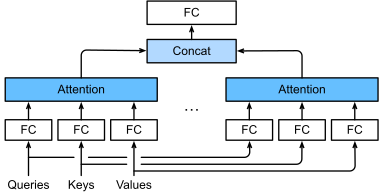
To this end, instead of performing a single attention pooling, queries, keys, and values can be transformed with \(h\) independently learned linear projections. Then these \(h\) projected queries, keys, and values are fed into attention pooling in parallel. In the end, \(h\) attention-pooling outputs are concatenated and transformed with another learned linear projection to produce the final output. This design is called multi-head attention, where each of the \(h\) attention pooling outputs is a head (Vaswani et al. 2017). Using fully connected layers to perform learnable linear transformations, Figure 11.5.1 describes multi-head attention.
from d2l import tensorflow as d2l
import tensorflow as tf
from d2l import jax as d2l
from flax import linen as nn
from jax import numpy as jnp
import jaxfrom d2l import mxnet as d2l
import math
from mxnet import autograd, np, npx
from mxnet.gluon import nn
npx.set_np()11.5.1 Model
Before providing the implementation of multi-head attention, let’s formalize this model mathematically. Given a query \(\mathbf{q} \in \mathbb{R}^{d_q}\), a key \(\mathbf{k} \in \mathbb{R}^{d_k}\), and a value \(\mathbf{v} \in \mathbb{R}^{d_v}\), each attention head \(\mathbf{h}_i\) (\(i = 1, \ldots, h\)) is computed as
\[\mathbf{h}_i = f(\mathbf W_i^{(q)}\mathbf q, \mathbf W_i^{(k)}\mathbf k,\mathbf W_i^{(v)}\mathbf v) \in \mathbb R^{p_v}, \tag{11.5.1}\]
where \(\mathbf W_i^{(q)}\in\mathbb R^{p_q\times d_q}\), \(\mathbf W_i^{(k)}\in\mathbb R^{p_k\times d_k}\), and \(\mathbf W_i^{(v)}\in\mathbb R^{p_v\times d_v}\) are learnable parameters and \(f\) is attention pooling, such as additive attention and scaled dot product attention in Section 11.3. The multi-head attention output is another linear transformation via learnable parameters \(\mathbf W_o\in\mathbb R^{p_o\times h p_v}\) of the concatenation of \(h\) heads:
\[\mathbf W_o \begin{bmatrix}\mathbf h_1\\\vdots\\\mathbf h_h\end{bmatrix} \in \mathbb{R}^{p_o}. \tag{11.5.2}\]
Based on this design, each head may attend to different parts of the input. More sophisticated functions than the simple weighted average can be expressed.
11.5.2 Implementation
In our implementation, we choose the scaled dot product attention for each head of the multi-head attention. To avoid significant growth of computational cost and parametrization cost, we set \(p_q = p_k = p_v = p_o / h\). Note that \(h\) heads can be computed in parallel if we set the number of outputs of linear transformations for the query, key, and value to \(p_q h = p_k h = p_v h = p_o\). In the following implementation, \(p_o\) is specified via the argument num_hiddens.
class MultiHeadAttention(d2l.Module):
    """Multi-head attention."""
    def __init__(self, num_hiddens, num_heads, dropout, bias=False, **kwargs):
        super().__init__()
        self.num_heads = num_heads
        self.attention = d2l.DotProductAttention(dropout)
        self.W_q = nn.LazyLinear(num_hiddens, bias=bias)
        self.W_k = nn.LazyLinear(num_hiddens, bias=bias)
        self.W_v = nn.LazyLinear(num_hiddens, bias=bias)
        self.W_o = nn.LazyLinear(num_hiddens, bias=bias)

    def forward(self, queries, keys, values, valid_lens):
        # Shape of queries, keys, or values:
        # (batch_size, no. of queries or key-value pairs, num_hiddens)
        # Shape of valid_lens: (batch_size,) or (batch_size, no. of queries)
        # After transposing, shape of output queries, keys, or values:
        # (batch_size * num_heads, no. of queries or key-value pairs,
        # num_hiddens / num_heads)
        queries = self.transpose_qkv(self.W_q(queries))
        keys = self.transpose_qkv(self.W_k(keys))
        values = self.transpose_qkv(self.W_v(values))

        if valid_lens is not None:
            # On axis 0, copy the first item (scalar or vector) for num_heads
            # times, then copy the next item, and so on
            valid_lens = torch.repeat_interleave(
                valid_lens, repeats=self.num_heads, dim=0)

        # Shape of output: (batch_size * num_heads, no. of queries,
        # num_hiddens / num_heads)
        output = self.attention(queries, keys, values, valid_lens)
        # Shape of output_concat: (batch_size, no. of queries, num_hiddens)
        output_concat = self.transpose_output(output)
        return self.W_o(output_concat)
class MultiHeadAttention(d2l.Module):
"""Multi-head attention."""
def __init__(self, key_size, query_size, value_size, num_hiddens,
num_heads, dropout, bias=False, **kwargs):
super().__init__()
self.num_heads = num_heads
self.attention = d2l.DotProductAttention(dropout)
self.W_q = tf.keras.layers.Dense(num_hiddens, use_bias=bias)
self.W_k = tf.keras.layers.Dense(num_hiddens, use_bias=bias)
self.W_v = tf.keras.layers.Dense(num_hiddens, use_bias=bias)
self.W_o = tf.keras.layers.Dense(num_hiddens, use_bias=bias)
def call(self, queries, keys, values, valid_lens, training=False, **kwargs):
# Shape of queries, keys, or values:
# (batch_size, no. of queries or key-value pairs, num_hiddens)
# Shape of valid_lens: (batch_size,) or (batch_size, no. of queries)
# After transposing, shape of output queries, keys, or values:
# (batch_size * num_heads, no. of queries or key-value pairs,
# num_hiddens / num_heads)
queries = self.transpose_qkv(self.W_q(queries))
keys = self.transpose_qkv(self.W_k(keys))
values = self.transpose_qkv(self.W_v(values))
if valid_lens is not None:
# On axis 0, copy the first item (scalar or vector) for num_heads
# times, then copy the next item, and so on
valid_lens = tf.repeat(valid_lens, repeats=self.num_heads, axis=0)
# Shape of output: (batch_size * num_heads, no. of queries,
# num_hiddens / num_heads)
output = self.attention(queries, keys, values, valid_lens,
training=training)
# Shape of output_concat: (batch_size, no. of queries, num_hiddens)
output_concat = self.transpose_output(output)
return self.W_o(output_concat)class MultiHeadAttention(nn.Module):
num_hiddens: int
num_heads: int
dropout: float
bias: bool = False
def setup(self):
self.attention = d2l.DotProductAttention(self.dropout)
self.W_q = nn.Dense(self.num_hiddens, use_bias=self.bias)
self.W_k = nn.Dense(self.num_hiddens, use_bias=self.bias)
self.W_v = nn.Dense(self.num_hiddens, use_bias=self.bias)
self.W_o = nn.Dense(self.num_hiddens, use_bias=self.bias)
@nn.compact
def __call__(self, queries, keys, values, valid_lens, training=False):
# Shape of queries, keys, or values:
# (batch_size, no. of queries or key-value pairs, num_hiddens)
# Shape of valid_lens: (batch_size,) or (batch_size, no. of queries)
# After transposing, shape of output queries, keys, or values:
# (batch_size * num_heads, no. of queries or key-value pairs,
# num_hiddens / num_heads)
queries = self.transpose_qkv(self.W_q(queries))
keys = self.transpose_qkv(self.W_k(keys))
values = self.transpose_qkv(self.W_v(values))
if valid_lens is not None:
# On axis 0, copy the first item (scalar or vector) for num_heads
# times, then copy the next item, and so on
valid_lens = jnp.repeat(valid_lens, self.num_heads, axis=0)
# Shape of output: (batch_size * num_heads, no. of queries,
# num_hiddens / num_heads)
output, attention_weights = self.attention(
queries, keys, values, valid_lens, training=training)
# Shape of output_concat: (batch_size, no. of queries, num_hiddens)
output_concat = self.transpose_output(output)
return self.W_o(output_concat), attention_weightsclass MultiHeadAttention(d2l.Module):
"""Multi-head attention."""
def __init__(self, num_hiddens, num_heads, dropout, use_bias=False,
**kwargs):
super().__init__()
self.num_heads = num_heads
self.attention = d2l.DotProductAttention(dropout)
self.W_q = nn.Dense(num_hiddens, use_bias=use_bias, flatten=False)
self.W_k = nn.Dense(num_hiddens, use_bias=use_bias, flatten=False)
self.W_v = nn.Dense(num_hiddens, use_bias=use_bias, flatten=False)
self.W_o = nn.Dense(num_hiddens, use_bias=use_bias, flatten=False)
def forward(self, queries, keys, values, valid_lens):
# Shape of queries, keys, or values:
# (batch_size, no. of queries or key-value pairs, num_hiddens)
# Shape of valid_lens: (batch_size,) or (batch_size, no. of queries)
# After transposing, shape of output queries, keys, or values:
# (batch_size * num_heads, no. of queries or key-value pairs,
# num_hiddens / num_heads)
queries = self.transpose_qkv(self.W_q(queries))
keys = self.transpose_qkv(self.W_k(keys))
values = self.transpose_qkv(self.W_v(values))
if valid_lens is not None:
# On axis 0, copy the first item (scalar or vector) for num_heads
# times, then copy the next item, and so on
valid_lens = valid_lens.repeat(self.num_heads, axis=0)
# Shape of output: (batch_size * num_heads, no. of queries,
# num_hiddens / num_heads)
output = self.attention(queries, keys, values, valid_lens)
# Shape of output_concat: (batch_size, no. of queries, num_hiddens)
output_concat = self.transpose_output(output)
return self.W_o(output_concat)To allow for parallel computation of multiple heads, the above MultiHeadAttention class uses two transposition methods as defined below. Specifically, the transpose_output method reverses the operation of the transpose_qkv method.
@d2l.add_to_class(MultiHeadAttention)
def transpose_qkv(self, X):
    """Transposition for parallel computation of multiple attention heads."""
    # Shape of input X: (batch_size, no. of queries or key-value pairs,
    # num_hiddens). Shape of output X: (batch_size, no. of queries or
    # key-value pairs, num_heads, num_hiddens / num_heads)
    X = X.reshape(X.shape[0], X.shape[1], self.num_heads, -1)
    # Shape of output X: (batch_size, num_heads, no. of queries or key-value
    # pairs, num_hiddens / num_heads)
    X = X.permute(0, 2, 1, 3)
    # Shape of output: (batch_size * num_heads, no. of queries or key-value
    # pairs, num_hiddens / num_heads)
    return X.reshape(-1, X.shape[2], X.shape[3])

@d2l.add_to_class(MultiHeadAttention)
def transpose_output(self, X):
    """Reverse the operation of transpose_qkv."""
    X = X.reshape(-1, self.num_heads, X.shape[1], X.shape[2])
    X = X.permute(0, 2, 1, 3)
return X.reshape(X.shape[0], X.shape[1], -1)@d2l.add_to_class(MultiHeadAttention)
def transpose_qkv(self, X):
"""Transposition for parallel computation of multiple attention heads."""
# Shape of input X: (batch_size, no. of queries or key-value pairs,
# num_hiddens). Shape of output X: (batch_size, no. of queries or
# key-value pairs, num_heads, num_hiddens / num_heads)
X = tf.reshape(X, (tf.shape(X)[0], tf.shape(X)[1], self.num_heads, -1))
# Shape of output X: (batch_size, num_heads, no. of queries or key-value
# pairs, num_hiddens / num_heads)
X = tf.transpose(X, perm=(0, 2, 1, 3))
# Shape of output: (batch_size * num_heads, no. of queries or key-value
# pairs, num_hiddens / num_heads)
return tf.reshape(X, (-1, tf.shape(X)[2], tf.shape(X)[3]))
@d2l.add_to_class(MultiHeadAttention)
def transpose_output(self, X):
"""Reverse the operation of transpose_qkv."""
X = tf.reshape(X, (-1, self.num_heads, tf.shape(X)[1], tf.shape(X)[2]))
X = tf.transpose(X, perm=(0, 2, 1, 3))
return tf.reshape(X, (tf.shape(X)[0], tf.shape(X)[1], -1))@d2l.add_to_class(MultiHeadAttention)
def transpose_qkv(self, X):
"""Transposition for parallel computation of multiple attention heads."""
# Shape of input X: (batch_size, no. of queries or key-value pairs,
# num_hiddens). Shape of output X: (batch_size, no. of queries or
# key-value pairs, num_heads, num_hiddens / num_heads)
X = X.reshape((X.shape[0], X.shape[1], self.num_heads, -1))
# Shape of output X: (batch_size, num_heads, no. of queries or key-value
# pairs, num_hiddens / num_heads)
X = jnp.transpose(X, (0, 2, 1, 3))
# Shape of output: (batch_size * num_heads, no. of queries or key-value
# pairs, num_hiddens / num_heads)
return X.reshape((-1, X.shape[2], X.shape[3]))
@d2l.add_to_class(MultiHeadAttention)
def transpose_output(self, X):
"""Reverse the operation of transpose_qkv."""
X = X.reshape((-1, self.num_heads, X.shape[1], X.shape[2]))
X = jnp.transpose(X, (0, 2, 1, 3))
return X.reshape((X.shape[0], X.shape[1], -1))@d2l.add_to_class(MultiHeadAttention)
def transpose_qkv(self, X):
"""Transposition for parallel computation of multiple attention heads."""
# Shape of input X: (batch_size, no. of queries or key-value pairs,
# num_hiddens). Shape of output X: (batch_size, no. of queries or
# key-value pairs, num_heads, num_hiddens / num_heads)
X = X.reshape(X.shape[0], X.shape[1], self.num_heads, -1)
# Shape of output X: (batch_size, num_heads, no. of queries or key-value
# pairs, num_hiddens / num_heads)
X = X.transpose(0, 2, 1, 3)
# Shape of output: (batch_size * num_heads, no. of queries or key-value
# pairs, num_hiddens / num_heads)
return X.reshape(-1, X.shape[2], X.shape[3])
@d2l.add_to_class(MultiHeadAttention)
def transpose_output(self, X):
"""Reverse the operation of transpose_qkv."""
X = X.reshape(-1, self.num_heads, X.shape[1], X.shape[2])
X = X.transpose(0, 2, 1, 3)
return X.reshape(X.shape[0], X.shape[1], -1)Let’s test our implemented MultiHeadAttention class using a toy example where keys and values are the same. As a result, the shape of the multi-head attention output is (batch_size, num_queries, num_hiddens).
num_hiddens, num_heads = 100, 5
attention = MultiHeadAttention(num_hiddens, num_heads, 0.5)
batch_size, num_queries, num_kvpairs = 2, 4, 6
valid_lens = d2l.tensor([3, 2])
X = d2l.ones((batch_size, num_queries, num_hiddens))
Y = d2l.ones((batch_size, num_kvpairs, num_hiddens))
d2l.check_shape(attention(X, Y, Y, valid_lens),
                (batch_size, num_queries, num_hiddens))
num_hiddens, num_heads = 100, 5
attention = MultiHeadAttention(num_hiddens, num_hiddens, num_hiddens,
num_hiddens, num_heads, 0.5)num_hiddens, num_heads = 100, 5
attention = MultiHeadAttention(num_hiddens, num_heads, 0.5)num_hiddens, num_heads = 100, 5
attention = MultiHeadAttention(num_hiddens, num_heads, 0.5)
attention.initialize()batch_size, num_queries, num_kvpairs = 2, 4, 6
valid_lens = d2l.tensor([3, 2])
X = tf.ones((batch_size, num_queries, num_hiddens))
Y = tf.ones((batch_size, num_kvpairs, num_hiddens))
d2l.check_shape(attention(X, Y, Y, valid_lens, training=False),
(batch_size, num_queries, num_hiddens))batch_size, num_queries, num_kvpairs = 2, 4, 6
valid_lens = d2l.tensor([3, 2])
X = d2l.ones((batch_size, num_queries, num_hiddens))
Y = d2l.ones((batch_size, num_kvpairs, num_hiddens))
d2l.check_shape(attention.init_with_output(d2l.get_key(), X, Y, Y, valid_lens,
training=False)[0][0],
(batch_size, num_queries, num_hiddens))batch_size, num_queries, num_kvpairs = 2, 4, 6
valid_lens = d2l.tensor([3, 2])
X = d2l.ones((batch_size, num_queries, num_hiddens))
Y = d2l.ones((batch_size, num_kvpairs, num_hiddens))
d2l.check_shape(attention(X, Y, Y, valid_lens),
(batch_size, num_queries, num_hiddens))11.5.3 Summary
Multi-head attention combines knowledge of the same attention pooling via different representation subspaces of queries, keys, and values. To compute multiple heads of multi-head attention in parallel, proper tensor manipulation is needed.
11.5.4 Exercises
- Visualize attention weights of multiple heads in this experiment.
- Suppose that we have a trained model based on multi-head attention and we want to prune less important attention heads to increase the prediction speed. How can we design experiments to measure the importance of an attention head?