import time
from d2l import torch as d2l
from scipy import stats19.2 Hyperparameter Optimization API
Before we dive into the methodology, we will first discuss a basic code structure that allows us to efficiently implement various HPO algorithms. In general, all HPO algorithms considered here need to implement two decision making primitives, searching and scheduling. First, they need to sample new hyperparameter configurations, which often involves some kind of search over the configuration space. Second, for each configuration, an HPO algorithm needs to schedule its evaluation and decide how many resources to allocate for it. Once we start to evaluate a configuration, we will refer to it as a trial. We map these decisions to two classes, HPOSearcher and HPOScheduler. On top of that, we also provide a HPOTuner class that executes the optimization process.
This concept of scheduler and searcher is also implemented in popular HPO libraries, such as Syne Tune (Salinas et al. 2022), Ray Tune (Liaw et al. 2018) or Optuna (Akiba et al. 2019).
import time
from d2l import jax as d2l
import jax
from jax import numpy as jnp
from flax import linen as nn
import optax
import numpy as np
from scipy import stats
19.2.1 Searcher
Below we define a base class for searchers, which provides a new candidate configuration through the sample_configuration function. A simple way to implement this function would be to sample configurations uniformly at random, as we did for random search in Section 19.1. More sophisticated algorithms, such as Bayesian optimization, will make these decisions based on the performance of previous trials. As a result, these algorithms are able to sample more promising candidates over time. We add the update function in order to update the history of previous trials, which can then be exploited to improve our sampling distribution.
class HPOSearcher(d2l.HyperParameters):
    def sample_configuration() -> dict:
        raise NotImplementedError

    def update(self, config: dict, error: float, additional_info=None):
        pass
class HPOSearcher(d2l.HyperParameters):
def sample_configuration() -> dict:
raise NotImplementedError
def update(self, config: dict, error: float, additional_info=None):
passThe following code shows how to implement our random search optimizer from the previous section in this API. As a slight extension, we allow the user to prescribe the first configuration to be evaluated via initial_config, while subsequent ones are drawn at random.
class RandomSearcher(HPOSearcher):
    def __init__(self, config_space: dict, initial_config=None):
        self.save_hyperparameters()

    def sample_configuration(self) -> dict:
        if self.initial_config is not None:
            result = self.initial_config
            self.initial_config = None
        else:
            result = {
                name: domain.rvs()
                for name, domain in self.config_space.items()
            }
        return result
class RandomSearcher(HPOSearcher):
def __init__(self, config_space: dict, initial_config=None):
self.save_hyperparameters()
def sample_configuration(self) -> dict:
if self.initial_config is not None:
result = self.initial_config
self.initial_config = None
else:
result = {
name: domain.rvs()
for name, domain in self.config_space.items()
}
return result19.2.2 Scheduler
Beyond sampling configurations for new trials, we also need to decide when and for how long to run a trial. In practice, all these decisions are done by the HPOScheduler, which delegates the choice of new configurations to a HPOSearcher. The suggest method is called whenever some resource for training becomes available. Apart from invoking sample_configuration of a searcher, it may also decide upon parameters like max_epochs (i.e., how long to train the model for). The update method is called whenever a trial returns a new observation.
class HPOScheduler(d2l.HyperParameters):
    def suggest(self) -> dict:
        raise NotImplementedError

    def update(self, config: dict, error: float, info=None):
        raise NotImplementedError
class HPOScheduler(d2l.HyperParameters):
def suggest(self) -> dict:
raise NotImplementedError
def update(self, config: dict, error: float, info=None):
raise NotImplementedErrorTo implement random search, but also other HPO algorithms, we only need a basic scheduler that schedules a new configuration every time new resources become available.
class BasicScheduler(HPOScheduler):
    def __init__(self, searcher: HPOSearcher):
        self.save_hyperparameters()

    def suggest(self) -> dict:
        return self.searcher.sample_configuration()

    def update(self, config: dict, error: float, info=None):
        self.searcher.update(config, error, additional_info=info)
class BasicScheduler(HPOScheduler):
def __init__(self, searcher: HPOSearcher):
self.save_hyperparameters()
def suggest(self) -> dict:
return self.searcher.sample_configuration()
def update(self, config: dict, error: float, info=None):
self.searcher.update(config, error, additional_info=info)19.2.3 Tuner
Finally, we need a component that runs the scheduler/searcher and does some book-keeping of the results. The following code implements a sequential execution of the HPO trials that evaluates one training job after the next and will serve as a basic example. We will later use Syne Tune for more scalable distributed HPO cases.
class HPOTuner(d2l.HyperParameters):
    def __init__(self, scheduler: HPOScheduler, objective: callable):
        self.save_hyperparameters()
        # Bookkeeping results for plotting
        self.incumbent = None
        self.incumbent_error = None
        self.incumbent_trajectory = []
        self.cumulative_runtime = []
        self.current_runtime = 0
        self.records = []

    def run(self, number_of_trials):
        for i in range(number_of_trials):
            start_time = time.time()
            config = self.scheduler.suggest()
            print(f"Trial {i}: config = {config}")
            error = self.objective(**config)
            error = float(d2l.numpy(error.cpu()))
            self.scheduler.update(config, error)
            runtime = time.time() - start_time
            self.bookkeeping(config, error, runtime)
            print(f"    error = {error}, runtime = {runtime}")
class HPOTuner(d2l.HyperParameters):
def __init__(self, scheduler: HPOScheduler, objective: callable):
self.save_hyperparameters()
# Bookkeeping results for plotting
self.incumbent = None
self.incumbent_error = None
self.incumbent_trajectory = []
self.cumulative_runtime = []
self.current_runtime = 0
self.records = []
def run(self, number_of_trials):
for i in range(number_of_trials):
start_time = time.time()
config = self.scheduler.suggest()
print(f"Trial {i}: config = {config}")
error = self.objective(**config)
error = float(error)
self.scheduler.update(config, error)
runtime = time.time() - start_time
self.bookkeeping(config, error, runtime)
print(f" error = {error}, runtime = {runtime}")19.2.4 Bookkeeping the Performance of HPO Algorithms
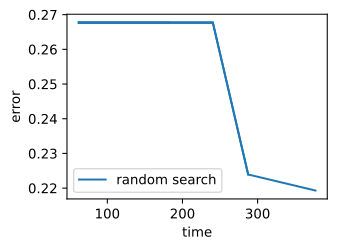
With any HPO algorithm, we are mostly interested in the best performing configuration (called incumbent) and its validation error after a given wall-clock time. This is why we track runtime per iteration, which includes both the time to run an evaluation (call of objective) and the time to make a decision (call of scheduler.suggest). In the sequel, we will plot cumulative_runtime against incumbent_trajectory in order to visualize the any-time performance of the HPO algorithm defined in terms of scheduler (and searcher). This allows us to quantify not only how well the configuration found by an optimizer works, but also how quickly an optimizer is able to find it.
@d2l.add_to_class(HPOTuner)
def bookkeeping(self, config: dict, error: float, runtime: float):
    self.records.append({"config": config, "error": error, "runtime": runtime})
    # Check if the last hyperparameter configuration performs better
    # than the incumbent
    if self.incumbent is None or self.incumbent_error > error:
        self.incumbent = config
        self.incumbent_error = error
    # Add current best observed performance to the optimization trajectory
    self.incumbent_trajectory.append(self.incumbent_error)
    # Update runtime
    self.current_runtime += runtime
self.cumulative_runtime.append(self.current_runtime)@d2l.add_to_class(HPOTuner)
def bookkeeping(self, config: dict, error: float, runtime: float):
self.records.append({"config": config, "error": error, "runtime": runtime})
# Check if the last hyperparameter configuration performs better
# than the incumbent
if self.incumbent is None or self.incumbent_error > error:
self.incumbent = config
self.incumbent_error = error
# Add current best observed performance to the optimization trajectory
self.incumbent_trajectory.append(self.incumbent_error)
# Update runtime
self.current_runtime += runtime
self.cumulative_runtime.append(self.current_runtime)19.2.5 Example: Optimizing the Hyperparameters of a Convolutional Neural Network
We now use our new implementation of random search to optimize the batch size and learning rate of the LeNet convolutional neural network from Section 7.6. We begin by defining the objective function, which will once more be validation error.
def hpo_objective_lenet(learning_rate, batch_size, max_epochs=10):
    model = d2l.LeNet(lr=learning_rate, num_classes=10)
    trainer = d2l.HPOTrainer(max_epochs=max_epochs, num_gpus=1)
    data = d2l.FashionMNIST(batch_size=batch_size)
    model.apply_init([next(iter(data.get_dataloader(True)))[0]], d2l.init_cnn)
    trainer.fit(model=model, data=data)
    validation_error = trainer.validation_error()
    return validation_error
def hpo_objective_lenet(learning_rate, batch_size, max_epochs=10):
model = d2l.LeNet(lr=learning_rate, num_classes=10)
trainer = d2l.HPOTrainer(max_epochs=max_epochs, num_gpus=1)
data = d2l.FashionMNIST(batch_size=batch_size)
trainer.fit(model=model, data=data)
validation_error = trainer.validation_error()
return validation_errorWe also need to define the configuration space. Moreover, the first configuration to be evaluated is the default setting used in Section 7.6.
config_space = {
    "learning_rate": stats.loguniform(1e-2, 1),
    "batch_size": stats.randint(32, 256),
}
initial_config = {
    "learning_rate": 0.1,
    "batch_size": 128,
}
Now we can start our random search:
searcher = RandomSearcher(config_space, initial_config=initial_config)
scheduler = BasicScheduler(searcher=searcher)
tuner = HPOTuner(scheduler=scheduler, objective=hpo_objective_lenet)
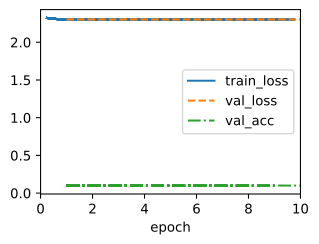
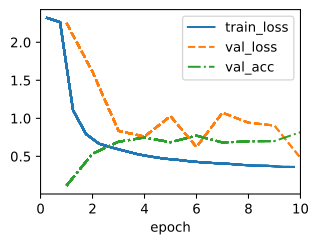
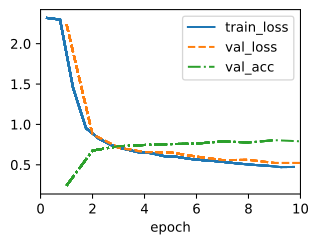
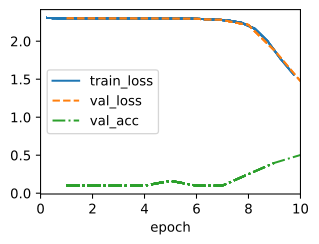
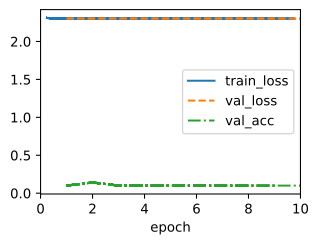
tuner.run(number_of_trials=5) error = 0.9003896117210388, runtime = 46.75638484954834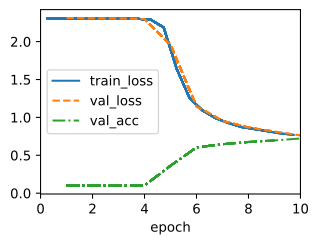
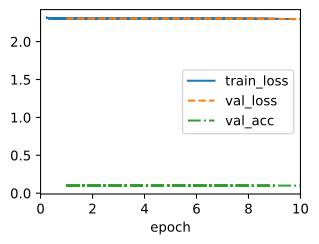
error = 0.21929657459259033, runtime = 89.50622367858887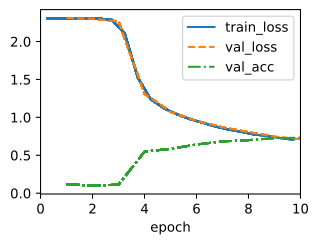
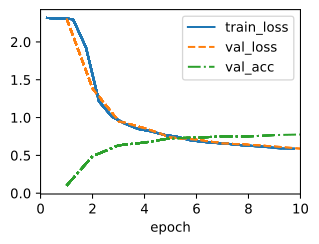
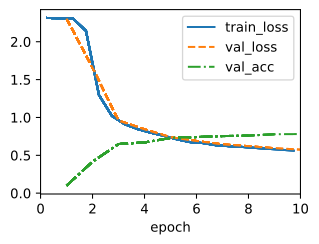
Below we plot the optimization trajectory of the incumbent to get the any-time performance of random search:
board = d2l.ProgressBoard(xlabel="time", ylabel="error")
for time_stamp, error in zip(
    tuner.cumulative_runtime, tuner.incumbent_trajectory
):
    board.draw(time_stamp, error, "random search", every_n=1)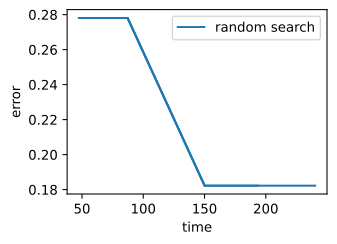
19.2.6 Comparing HPO Algorithms
Just as with training algorithms or model architectures, it is important to understand how to best compare different HPO algorithms. Each HPO run depends on two major sources of randomness: the random effects of the training process, such as random weight initialization or mini-batch ordering, and the intrinsic randomness of the HPO algorithm itself, such as the random sampling of random search. Hence, when comparing different algorithms, it is crucial to run each experiment several times and report statistics, such as mean or median, across a population of multiple repetitions of an algorithm based on different seeds of the random number generator.
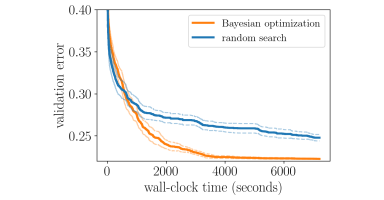
To illustrate this, we compare random search (see Section 19.1.2) and Bayesian optimization (Snoek et al. 2012) on tuning the hyperparameters of a feed-forward neural network. Each algorithm was evaluated \(50\) times with a different random seed. The solid line indicates the average performance of the incumbent across these \(50\) repetitions and the dashed line the standard deviation. We can see that random search and Bayesian optimization perform roughly the same up to ~1000 seconds, but Bayesian optimization can make use of the past observation to identify better configurations and thus quickly outperforms random search afterwards.
19.2.7 Summary
This section laid out a simple, yet flexible interface to implement various HPO algorithms that we will look at in this chapter. Similar interfaces can be found in popular open-source HPO frameworks. We also looked at how we can compare HPO algorithms, and potential pitfalls one needs to be aware of.
19.2.8 Exercises
- The goal of this exercise is to implement the objective function for a slightly more challenging HPO problem, and to run more realistic experiments. We will use the two hidden layer MLP
DropoutMLPimplemented in Section 5.6.- Code up the objective function, which should depend on all hyperparameters of the model and
batch_size. Usemax_epochs=50. GPUs do not help here, sonum_gpus=0. Hint: Modifyhpo_objective_lenet. - Choose a sensible search space, where
num_hiddens_1,num_hiddens_2are integers in \([8, 1024]\), and dropout values lie in \([0, 0.95]\), whilebatch_sizelies in \([16, 384]\). Provide code forconfig_space, using sensible distributions fromscipy.stats. - Run random search on this example with
number_of_trials=20and plot the results. Make sure to first evaluate the default configuration of Section 5.6, which isinitial_config = {'num_hiddens_1': 256, 'num_hiddens_2': 256, 'dropout_1': 0.5, 'dropout_2': 0.5, 'lr': 0.1, 'batch_size': 256}.
- Code up the objective function, which should depend on all hyperparameters of the model and
- In this exercise, you will implement a new searcher (subclass of
HPOSearcher) which makes decisions based on past data. It depends on parametersprobab_local,num_init_random. Itssample_configurationmethod works as follows. For the firstnum_init_randomcalls, do the same asRandomSearcher.sample_configuration. Otherwise, with probability1 - probab_local, do the same asRandomSearcher.sample_configuration. Otherwise, pick the configuration which attained the smallest validation error so far, select one of its hyperparameters at random, and sample its value randomly like inRandomSearcher.sample_configuration, but leave all other values the same. Return this configuration, which is identical to the best configuration so far, except in this one hyperparameter.- Code up this new
LocalSearcher. Hint: Your searcher requiresconfig_spaceas argument at construction. Feel free to use a member of typeRandomSearcher. You will also have to implement theupdatemethod. - Re-run the experiment from the previous exercise, but using your new searcher instead of
RandomSearcher. Experiment with different values forprobab_local,num_init_random. However, note that a proper comparison between different HPO methods requires repeating experiments several times, and ideally considering a number of benchmark tasks.
- Code up this new