from d2l import torch as d2l
import json
import multiprocessing
import torch
from torch import nn
import os16.7 Natural Language Inference: Fine-Tuning BERT
In earlier sections of this chapter, we have designed an attention-based architecture (in Section 16.5) for the natural language inference task on the SNLI dataset (as described in Section 16.4). Now we revisit this task by fine-tuning BERT. As discussed in Section 16.6, natural language inference is a sequence-level text pair classification problem, and fine-tuning BERT only requires an additional MLP-based architecture, as illustrated in Figure 16.7.1.
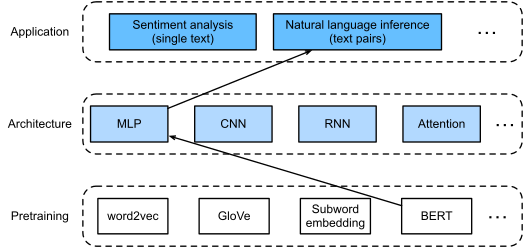
In this section, we will download a pretrained small version of BERT, then fine-tune it for natural language inference on the SNLI dataset.
from d2l import jax as d2l
import jax
from jax import numpy as jnp
from flax import linen as nn
import optax
import numpy as np
import json
import os
from d2l import mxnet as d2l
import json
import multiprocessing
from mxnet import gluon, np, npx
from mxnet.gluon import nn
import os
npx.set_np()16.7.1 Loading Pretrained BERT
We have explained how to pretrain BERT on the WikiText-2 dataset in Section 15.9 and Section 15.10 (note that the original BERT model is pretrained on much bigger corpora). As discussed in Section 15.10, the original BERT model has hundreds of millions of parameters. In the following, we provide two versions of pretrained BERT: “bert.base” is about as big as the original BERT base model that requires a lot of computational resources to fine-tune, while “bert.small” is a small version to facilitate demonstration.
d2l.DATA_HUB['bert.base'] = (d2l.DATA_URL + 'bert.base.torch.zip',
                             '225d66f04cae318b841a13d32af3acc165f253ac')
d2l.DATA_HUB['bert.small'] = (d2l.DATA_URL + 'bert.small.torch.zip',
'c72329e68a732bef0452e4b96a1c341c8910f81f')d2l.DATA_HUB['bert.base'] = (d2l.DATA_URL + 'bert.base.torch.zip',
'225d66f04cae318b841a13d32af3acc165f253ac')
d2l.DATA_HUB['bert.small'] = (d2l.DATA_URL + 'bert.small.torch.zip',
'c72329e68a732bef0452e4b96a1c341c8910f81f')
def _load_torch_state_dict(path):
"""Load a PyTorch state-dict file as {str: numpy.ndarray} without torch.
Works for files saved with ``torch.save(model.state_dict(), path)``
using pickle protocol 2 (the default for PyTorch <= 2.x CPU tensors).
"""
import pickle, struct, io
from collections import OrderedDict
dtype_info = {
'FloatStorage': (np.float32, 4), 'HalfStorage': (np.float16, 2),
'LongStorage': (np.int64, 8), 'IntStorage': (np.int32, 4),
'DoubleStorage': (np.float64, 8),
}
class _StorageRef:
__slots__ = ('dtype_name', 'key', 'location', 'size')
def __init__(self, dtype_name, key, location, size):
self.dtype_name = dtype_name; self.key = key
self.location = location; self.size = size
class _TensorRef:
__slots__ = ('storage', 'offset', 'size', 'stride')
def __init__(self, storage, offset, size, stride):
self.storage = storage; self.offset = offset
self.size = tuple(size); self.stride = tuple(stride)
class _StorageType:
__slots__ = ('name',)
def __init__(self, name): self.name = name
def __call__(self, _): return self
class _Unpickler(pickle.Unpickler):
def find_class(self, module, name):
if module == 'collections' and name == 'OrderedDict':
return OrderedDict
if module == 'torch._utils' and name == '_rebuild_tensor_v2':
return (lambda s, o, sz, st, *a, **k:
_TensorRef(s, o, sz, st))
if module == 'torch' and name in dtype_info:
return _StorageType(name)
return super().find_class(module, name)
def persistent_load(self, saved_id):
if isinstance(saved_id, tuple) and saved_id[0] == 'storage':
st = saved_id[1]
return _StorageRef(
st.name if isinstance(st, _StorageType) else 'FloatStorage',
saved_id[2], saved_id[3], saved_id[4])
raise RuntimeError(f'Unknown persistent id: {saved_id}')
with open(path, 'rb') as f:
content = f.read()
buf = io.BytesIO(content)
for _ in range(3): # skip magic, proto, sysinfo
_Unpickler(buf).load()
data = _Unpickler(buf).load() # OrderedDict of _TensorRef
storage_keys = _Unpickler(buf).load() # list of storage keys
pos = buf.tell()
key_dtype = {}
for tref in data.values():
if isinstance(tref, _TensorRef):
key_dtype[tref.storage.key] = tref.storage.dtype_name
storages = {}
for key in storage_keys:
dname = key_dtype.get(key, 'FloatStorage')
np_dt, esz = dtype_info[dname]
n = struct.unpack('<Q', content[pos:pos+8])[0]; pos += 8
storages[key] = np.frombuffer(content, np_dt, count=n, offset=pos)
pos += n * esz
result = OrderedDict()
for name, tref in data.items():
if isinstance(tref, _TensorRef):
s = storages[tref.storage.key]
ne = 1
for d in tref.size:
ne *= d
result[name] = s[tref.offset:tref.offset+ne].reshape(
tref.size).copy()
return resultd2l.DATA_HUB['bert.base'] = (d2l.DATA_URL + 'bert.base.zip',
'7b3820b35da691042e5d34c0971ac3edbd80d3f4')
d2l.DATA_HUB['bert.small'] = (d2l.DATA_URL + 'bert.small.zip',
'a4e718a47137ccd1809c9107ab4f5edd317bae2c')Either pretrained BERT model contains a “vocab.json” file that defines the vocabulary set and a “pretrained.params” file of the pretrained parameters. We implement the following load_pretrained_model function to load pretrained BERT parameters.
def load_pretrained_model(pretrained_model, num_hiddens, ffn_num_hiddens,
                          num_heads, num_blks, dropout, max_len, devices):
    data_dir = d2l.download_extract(pretrained_model)
    # Define an empty vocabulary to load the predefined vocabulary
    vocab = d2l.Vocab()
    vocab.idx_to_token = json.load(open(os.path.join(data_dir, 'vocab.json')))
    vocab.token_to_idx = {token: idx for idx, token in enumerate(
        vocab.idx_to_token)}
    bert = d2l.BERTModel(
        len(vocab), num_hiddens, ffn_num_hiddens=ffn_num_hiddens, num_heads=4,
        num_blks=2, dropout=0.2, max_len=max_len)
    # Load pretrained BERT parameters
    bert.load_state_dict(torch.load(os.path.join(data_dir,
                                                 'pretrained.params')))
    return bert, vocab
def load_pretrained_model(pretrained_model, num_hiddens, ffn_num_hiddens,
num_heads, num_blks, dropout, max_len, devices):
data_dir = d2l.download_extract(pretrained_model)
# Define an empty vocabulary to load the predefined vocabulary
vocab = d2l.Vocab()
vocab.idx_to_token = json.load(open(os.path.join(data_dir, 'vocab.json')))
vocab.token_to_idx = {token: idx for idx, token in enumerate(
vocab.idx_to_token)}
bert = d2l.BERTModel(
len(vocab), num_hiddens, ffn_num_hiddens=ffn_num_hiddens, num_heads=4,
num_blks=2, dropout=0.2, max_len=max_len)
# Initialize model parameters with dummy inputs
dummy_tokens = jnp.ones((2, max_len), dtype=jnp.int32)
dummy_segments = jnp.zeros((2, max_len), dtype=jnp.int32)
dummy_valid_lens = jnp.array([max_len, max_len], dtype=jnp.float32)
key = jax.random.PRNGKey(0)
params = bert.init(key, dummy_tokens, dummy_segments, dummy_valid_lens,
training=False)
# Load pretrained PyTorch BERT parameters (as numpy) and convert to JAX
pt_state_dict = _load_torch_state_dict(
os.path.join(data_dir, 'pretrained.params'))
params = _convert_torch_to_jax_bert(params, pt_state_dict)
return bert, vocab, params
def _convert_torch_to_jax_bert(params, pt_state_dict):
"""Convert PyTorch BERT state dict (numpy arrays) to JAX/Flax params."""
import copy
new_params = copy.deepcopy(dict(params))
p = pt_state_dict
jax_p = new_params['params']
# Encoder: token, segment, position embeddings
enc = jax_p['encoder']
enc['token_embedding']['embedding'] = jnp.array(
p['encoder.token_embedding.weight'])
enc['segment_embedding']['embedding'] = jnp.array(
p['encoder.segment_embedding.weight'])
enc['pos_embedding'] = jnp.array(
p['encoder.pos_embedding'])
# Transformer encoder blocks
for i in range(2):
prefix = f'encoder.blks.{i}'
blk = enc[f'blks_{i}']
# Multi-head attention
attn = blk['attention']
for name in ['W_q', 'W_k', 'W_v', 'W_o']:
attn[name]['kernel'] = jnp.array(
p[f'{prefix}.attention.{name}.weight'].T)
attn[name]['bias'] = jnp.array(
p[f'{prefix}.attention.{name}.bias'])
# Addnorm layers (LayerNorm)
for ln_name in ['addnorm1', 'addnorm2']:
blk[ln_name]['LayerNorm_0']['scale'] = jnp.array(
p[f'{prefix}.{ln_name}.ln.weight'])
blk[ln_name]['LayerNorm_0']['bias'] = jnp.array(
p[f'{prefix}.{ln_name}.ln.bias'])
# FFN
ffn = blk['ffn']
ffn['dense1']['kernel'] = jnp.array(
p[f'{prefix}.ffn.dense1.weight'].T)
ffn['dense1']['bias'] = jnp.array(
p[f'{prefix}.ffn.dense1.bias'])
ffn['dense2']['kernel'] = jnp.array(
p[f'{prefix}.ffn.dense2.weight'].T)
ffn['dense2']['bias'] = jnp.array(
p[f'{prefix}.ffn.dense2.bias'])
# Hidden (tanh) layer
jax_p['hidden']['kernel'] = jnp.array(
p['hidden.0.weight'].T)
jax_p['hidden']['bias'] = jnp.array(
p['hidden.0.bias'])
new_params['params'] = jax_p
return new_paramsdef load_pretrained_model(pretrained_model, num_hiddens, ffn_num_hiddens,
num_heads, num_blks, dropout, max_len, devices):
data_dir = d2l.download_extract(pretrained_model)
# Define an empty vocabulary to load the predefined vocabulary
vocab = d2l.Vocab()
vocab.idx_to_token = json.load(open(os.path.join(data_dir, 'vocab.json')))
vocab.token_to_idx = {token: idx for idx, token in enumerate(
vocab.idx_to_token)}
bert = d2l.BERTModel(len(vocab), num_hiddens, ffn_num_hiddens, num_heads,
num_blks, dropout, max_len)
# Load pretrained BERT parameters
bert.load_parameters(os.path.join(data_dir, 'pretrained.params'),
ctx=devices)
return bert, vocabTo facilitate demonstration on most machines, we will load and fine-tune the small version (“bert.small”) of the pretrained BERT in this section. In the exercise, we will show how to fine-tune the much larger “bert.base” to significantly improve the testing accuracy.
devices = d2l.try_all_gpus()
bert, vocab = load_pretrained_model(
    'bert.small', num_hiddens=256, ffn_num_hiddens=512, num_heads=4,
    num_blks=2, dropout=0.1, max_len=512, devices=devices)
devices = d2l.try_all_gpus()
bert, vocab, bert_params = load_pretrained_model(
'bert.small', num_hiddens=256, ffn_num_hiddens=512, num_heads=4,
num_blks=2, dropout=0.1, max_len=512, devices=devices)devices = d2l.try_all_gpus()
bert, vocab = load_pretrained_model(
'bert.small', num_hiddens=256, ffn_num_hiddens=512, num_heads=4,
num_blks=2, dropout=0.1, max_len=512, devices=devices)16.7.2 The Dataset for Fine-Tuning BERT
For the downstream task natural language inference on the SNLI dataset, we define a customized dataset class SNLIBERTDataset. In each example, the premise and hypothesis form a pair of text sequence and is packed into one BERT input sequence as depicted in Figure 16.6.2. Recall Section 15.8.4 that segment IDs are used to distinguish the premise and the hypothesis in a BERT input sequence. With the predefined maximum length of a BERT input sequence (max_len), the last token of the longer of the input text pair keeps getting removed until max_len is met. To accelerate generation of the SNLI dataset for fine-tuning BERT, we use 4 worker processes to generate training or testing examples in parallel.
class SNLIBERTDataset(torch.utils.data.Dataset):
    def __init__(self, dataset, max_len, vocab=None):
        all_premise_hypothesis_tokens = [[
            p_tokens, h_tokens] for p_tokens, h_tokens in zip(
            *[d2l.tokenize([s.lower() for s in sentences])
              for sentences in dataset[:2]])]

        self.labels = torch.tensor(dataset[2])
        self.vocab = vocab
        self.max_len = max_len
        (self.all_token_ids, self.all_segments,
         self.valid_lens) = self._preprocess(all_premise_hypothesis_tokens)
        print('read ' + str(len(self.all_token_ids)) + ' examples')

    def _preprocess(self, all_premise_hypothesis_tokens):
        pool = multiprocessing.Pool(4)  # Use 4 worker processes
        out = pool.map(self._mp_worker, all_premise_hypothesis_tokens)
        all_token_ids = [
            token_ids for token_ids, segments, valid_len in out]
        all_segments = [segments for token_ids, segments, valid_len in out]
        valid_lens = [valid_len for token_ids, segments, valid_len in out]
        return (torch.tensor(all_token_ids, dtype=torch.long),
                torch.tensor(all_segments, dtype=torch.long),
                torch.tensor(valid_lens))

    def _mp_worker(self, premise_hypothesis_tokens):
        p_tokens, h_tokens = premise_hypothesis_tokens
        self._truncate_pair_of_tokens(p_tokens, h_tokens)
        tokens, segments = d2l.get_tokens_and_segments(p_tokens, h_tokens)
        token_ids = self.vocab[tokens] + [self.vocab['<pad>']] \
                             * (self.max_len - len(tokens))
        segments = segments + [0] * (self.max_len - len(segments))
        valid_len = len(tokens)
        return token_ids, segments, valid_len

    def _truncate_pair_of_tokens(self, p_tokens, h_tokens):
        # Reserve slots for '<CLS>', '<SEP>', and '<SEP>' tokens for the BERT
        # input
        while len(p_tokens) + len(h_tokens) > self.max_len - 3:
            if len(p_tokens) > len(h_tokens):
                p_tokens.pop()
            else:
                h_tokens.pop()

    def __getitem__(self, idx):
        return (self.all_token_ids[idx], self.all_segments[idx],
                self.valid_lens[idx]), self.labels[idx]

    def __len__(self):
        return len(self.all_token_ids)
class SNLIBERTDataset:
def __init__(self, dataset, max_len, vocab=None):
all_premise_hypothesis_tokens = [[
p_tokens, h_tokens] for p_tokens, h_tokens in zip(
*[d2l.tokenize([s.lower() for s in sentences])
for sentences in dataset[:2]])]
self.labels = jnp.array(dataset[2])
self.vocab = vocab
self.max_len = max_len
(self.all_token_ids, self.all_segments,
self.valid_lens) = self._preprocess(all_premise_hypothesis_tokens)
print('read ' + str(len(self.all_token_ids)) + ' examples')
def _preprocess(self, all_premise_hypothesis_tokens):
out = [self._mp_worker(tokens)
for tokens in all_premise_hypothesis_tokens]
all_token_ids = [
token_ids for token_ids, segments, valid_len in out]
all_segments = [segments for token_ids, segments, valid_len in out]
valid_lens = [valid_len for token_ids, segments, valid_len in out]
return (jnp.array(all_token_ids, dtype=jnp.int32),
jnp.array(all_segments, dtype=jnp.int32),
jnp.array(valid_lens))
def _mp_worker(self, premise_hypothesis_tokens):
p_tokens, h_tokens = premise_hypothesis_tokens
self._truncate_pair_of_tokens(p_tokens, h_tokens)
tokens, segments = d2l.get_tokens_and_segments(p_tokens, h_tokens)
token_ids = self.vocab[tokens] + [self.vocab['<pad>']] \
* (self.max_len - len(tokens))
segments = segments + [0] * (self.max_len - len(segments))
valid_len = len(tokens)
return token_ids, segments, valid_len
def _truncate_pair_of_tokens(self, p_tokens, h_tokens):
# Reserve slots for '<CLS>', '<SEP>', and '<SEP>' tokens for the BERT
# input
while len(p_tokens) + len(h_tokens) > self.max_len - 3:
if len(p_tokens) > len(h_tokens):
p_tokens.pop()
else:
h_tokens.pop()
def __getitem__(self, idx):
return (self.all_token_ids[idx], self.all_segments[idx],
self.valid_lens[idx]), self.labels[idx]
def __len__(self):
return len(self.all_token_ids)class SNLIBERTDataset(gluon.data.Dataset):
def __init__(self, dataset, max_len, vocab=None):
all_premise_hypothesis_tokens = [[
p_tokens, h_tokens] for p_tokens, h_tokens in zip(
*[d2l.tokenize([s.lower() for s in sentences])
for sentences in dataset[:2]])]
self.labels = np.array(dataset[2])
self.vocab = vocab
self.max_len = max_len
(self.all_token_ids, self.all_segments,
self.valid_lens) = self._preprocess(all_premise_hypothesis_tokens)
print('read ' + str(len(self.all_token_ids)) + ' examples')
def _preprocess(self, all_premise_hypothesis_tokens):
pool = multiprocessing.Pool(4) # Use 4 worker processes
out = pool.map(self._mp_worker, all_premise_hypothesis_tokens)
all_token_ids = [
token_ids for token_ids, segments, valid_len in out]
all_segments = [segments for token_ids, segments, valid_len in out]
valid_lens = [valid_len for token_ids, segments, valid_len in out]
return (np.array(all_token_ids, dtype='int32'),
np.array(all_segments, dtype='int32'),
np.array(valid_lens))
def _mp_worker(self, premise_hypothesis_tokens):
p_tokens, h_tokens = premise_hypothesis_tokens
self._truncate_pair_of_tokens(p_tokens, h_tokens)
tokens, segments = d2l.get_tokens_and_segments(p_tokens, h_tokens)
token_ids = self.vocab[tokens] + [self.vocab['<pad>']] \
* (self.max_len - len(tokens))
segments = segments + [0] * (self.max_len - len(segments))
valid_len = len(tokens)
return token_ids, segments, valid_len
def _truncate_pair_of_tokens(self, p_tokens, h_tokens):
# Reserve slots for '<CLS>', '<SEP>', and '<SEP>' tokens for the BERT
# input
while len(p_tokens) + len(h_tokens) > self.max_len - 3:
if len(p_tokens) > len(h_tokens):
p_tokens.pop()
else:
h_tokens.pop()
def __getitem__(self, idx):
return (self.all_token_ids[idx], self.all_segments[idx],
self.valid_lens[idx]), self.labels[idx]
def __len__(self):
return len(self.all_token_ids)After downloading the SNLI dataset, we generate training and testing examples by instantiating the SNLIBERTDataset class. Such examples will be read in minibatches during training and testing of natural language inference.
# Reduce `batch_size` if there is an out of memory error. In the original BERT
# model, `max_len` = 512
batch_size, max_len, num_workers = 512, 128, d2l.get_dataloader_workers()
data_dir = d2l.download_extract('SNLI')
train_set = SNLIBERTDataset(d2l.read_snli(data_dir, True), max_len, vocab)
test_set = SNLIBERTDataset(d2l.read_snli(data_dir, False), max_len, vocab)
train_iter = torch.utils.data.DataLoader(train_set, batch_size, shuffle=True,
                                   num_workers=num_workers)
test_iter = torch.utils.data.DataLoader(test_set, batch_size,
                                  num_workers=num_workers)
read 549367 examplesread 9824 examples# Reduce `batch_size` if there is an out of memory error. In the original BERT
# model, `max_len` = 512
batch_size, max_len = 512, 128
data_dir = d2l.download_extract('SNLI')
train_set = SNLIBERTDataset(d2l.read_snli(data_dir, True), max_len, vocab)
test_set = SNLIBERTDataset(d2l.read_snli(data_dir, False), max_len, vocab)
train_iter = d2l.load_array(
(train_set.all_token_ids, train_set.all_segments,
train_set.valid_lens, train_set.labels), batch_size, is_train=True)
test_iter = d2l.load_array(
(test_set.all_token_ids, test_set.all_segments,
test_set.valid_lens, test_set.labels), batch_size, is_train=False)read 549367 examplesread 9824 examples# Reduce `batch_size` if there is an out of memory error. In the original BERT
# model, `max_len` = 512
batch_size, max_len, num_workers = 512, 128, d2l.get_dataloader_workers()
data_dir = d2l.download_extract('SNLI')
train_set = SNLIBERTDataset(d2l.read_snli(data_dir, True), max_len, vocab)
test_set = SNLIBERTDataset(d2l.read_snli(data_dir, False), max_len, vocab)
train_iter = gluon.data.DataLoader(train_set, batch_size, shuffle=True,
num_workers=num_workers)
test_iter = gluon.data.DataLoader(test_set, batch_size,
num_workers=num_workers)read 549367 examplesread 9824 examples16.7.3 Fine-Tuning BERT
As Figure 16.6.2 indicates, fine-tuning BERT for natural language inference requires only an extra MLP consisting of two fully connected layers (see self.hidden and self.output in the following BERTClassifier class). This MLP transforms the BERT representation of the special “<cls>” token, which encodes the information of both the premise and the hypothesis, into three outputs of natural language inference: entailment, contradiction, and neutral.
class BERTClassifier(nn.Module):
    def __init__(self, bert):
        super(BERTClassifier, self).__init__()
        self.encoder = bert.encoder
        self.hidden = bert.hidden
        self.output = nn.LazyLinear(3)

    def forward(self, inputs):
        tokens_X, segments_X, valid_lens_x = inputs
        encoded_X = self.encoder(tokens_X, segments_X, valid_lens_x)
        return self.output(self.hidden(encoded_X[:, 0, :]))
class BERTClassifier(nn.Module):
bert: d2l.BERTModel
@nn.compact
def __call__(self, tokens_X, segments_X, valid_lens_x, training=False):
encoded_X = self.bert.encoder(
tokens_X, segments_X, valid_lens_x, training=training)
return nn.Dense(3)(
jnp.tanh(self.bert.hidden(encoded_X[:, 0, :])))class BERTClassifier(nn.Block):
def __init__(self, bert):
super(BERTClassifier, self).__init__()
self.encoder = bert.encoder
self.hidden = bert.hidden
self.output = nn.Dense(3)
def forward(self, inputs):
tokens_X, segments_X, valid_lens_x = inputs
encoded_X = self.encoder(tokens_X, segments_X, valid_lens_x)
return self.output(self.hidden(encoded_X[:, 0, :]))In the following, the pretrained BERT model bert is fed into the BERTClassifier instance net for the downstream application. In common implementations of BERT fine-tuning, only the parameters of the output layer of the additional MLP (net.output) will be learned from scratch. All the parameters of the pretrained BERT encoder (net.encoder) and the hidden layer of the additional MLP (net.hidden) will be fine-tuned.
net = BERTClassifier(bert)net = BERTClassifier(bert)
# Initialize the classifier with pretrained BERT parameters
dummy_tokens = jnp.ones((2, max_len), dtype=jnp.int32)
dummy_segments = jnp.zeros((2, max_len), dtype=jnp.int32)
dummy_valid_lens = jnp.array([max_len, max_len], dtype=jnp.float32)
rng = jax.random.PRNGKey(0)
params = net.init(rng, dummy_tokens, dummy_segments, dummy_valid_lens,
training=False)
# Copy pretrained BERT encoder and hidden layer parameters
import copy
new_params = copy.deepcopy(dict(params))
new_params['params']['bert'] = bert_params['params']
params = new_paramsnet = BERTClassifier(bert)
net.output.initialize(ctx=devices)Recall that in Section 15.8 both the MaskLM class and the NextSentencePred class have parameters in their employed MLPs. These parameters are part of those in the pretrained BERT model bert, and thus part of parameters in net. However, such parameters are only for computing the masked language modeling loss and the next sentence prediction loss during pretraining. These two loss functions are irrelevant to fine-tuning downstream applications, thus the parameters of the employed MLPs in MaskLM and NextSentencePred are not updated (staled) when BERT is fine-tuned.
To allow parameters with stale gradients, the flag ignore_stale_grad=True is set in the step function of d2l.train_batch_ch13. We use this function to train and evaluate the model net using the training set (train_iter) and the testing set (test_iter) of SNLI. Due to the limited computational resources, the training and testing accuracy can be further improved: we leave its discussions in the exercises.
lr, num_epochs = 1e-4, 5
trainer = torch.optim.Adam(net.parameters(), lr=lr)
loss = nn.CrossEntropyLoss(reduction='none')
net(next(iter(train_iter))[0])
d2l.train_ch13(net, train_iter, test_iter, loss, trainer, num_epochs, devices)
loss 0.520, train acc 0.791, test acc 0.778
11634.1 examples/sec on [device(type='cuda', index=0)]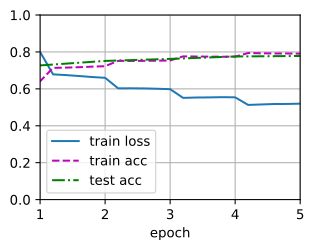
lr, num_epochs = 1e-4, 5
optimizer = optax.adam(lr)
opt_state = optimizer.init(params)

def loss_fn(params, tokens_X, segments_X, valid_lens_x, labels, rng):
    logits = net.apply(params, tokens_X, segments_X, valid_lens_x,
                       training=True, rngs={'dropout': rng})
    return optax.softmax_cross_entropy_with_integer_labels(
        logits, labels).mean()

@jax.jit
def train_step(params, opt_state, tokens_X, segments_X, valid_lens_x,
               labels, rng):
    loss, grads = jax.value_and_grad(loss_fn)(
        params, tokens_X, segments_X, valid_lens_x, labels, rng)
    updates, opt_state = optimizer.update(grads, opt_state, params)
    params = optax.apply_updates(params, updates)
    return params, opt_state, loss

@jax.jit
def eval_step(params, tokens_X, segments_X, valid_lens_x, labels):
    logits = net.apply(params, tokens_X, segments_X, valid_lens_x,
                       training=False)
    return (logits.argmax(axis=-1) == labels).sum()

rng = jax.random.PRNGKey(0)
for epoch in range(num_epochs):
    train_loss, n_train = 0.0, 0
    for batch in train_iter:
        tokens_X, segments_X, valid_lens_x, labels = (
            batch[0], batch[1], batch[2], batch[3])
        rng, step_rng = jax.random.split(rng)
        params, opt_state, loss = train_step(
            params, opt_state, tokens_X, segments_X, valid_lens_x,
            labels, step_rng)
        train_loss += float(loss) * len(labels)
        n_train += len(labels)
    # Evaluate on test set
    n_correct, n_test = 0, 0
    for batch in test_iter:
        tokens_X, segments_X, valid_lens_x, labels = (
            batch[0], batch[1], batch[2], batch[3])
        n_correct += int(eval_step(
            params, tokens_X, segments_X, valid_lens_x, labels))
        n_test += len(labels)
    print(f'epoch {epoch + 1}, loss {train_loss / n_train:.4f}, '
          f'test acc {n_correct / n_test:.4f}')
epoch 1, loss 0.8116, test acc 0.7127epoch 2, loss 0.6668, test acc 0.7555epoch 3, loss 0.6027, test acc 0.7573epoch 4, loss 0.5578, test acc 0.7763epoch 5, loss 0.5238, test acc 0.7744lr, num_epochs = 1e-4, 5
trainer = gluon.Trainer(net.collect_params(), 'adam', {'learning_rate': lr})
loss = gluon.loss.SoftmaxCrossEntropyLoss()
d2l.train_ch13(net, train_iter, test_iter, loss, trainer, num_epochs, devices,
d2l.split_batch_multi_inputs)loss 0.478, train acc 0.810, test acc 0.791
8520.9 examples/sec on [gpu(0)]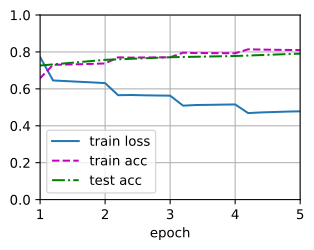
16.7.4 Summary
- We can fine-tune the pretrained BERT model for downstream applications, such as natural language inference on the SNLI dataset.
- During fine-tuning, the BERT model becomes part of the model for the downstream application. Parameters that are only related to pretraining loss will not be updated during fine-tuning.
16.7.5 Exercises
- Fine-tune a much larger pretrained BERT model that is about as big as the original BERT base model if your computational resource allows. Set arguments in the
load_pretrained_modelfunction as: replacing ‘bert.small’ with ‘bert.base’, increasing values ofnum_hiddens=256,ffn_num_hiddens=512,num_heads=4, andnum_blks=2to 768, 3072, 12, and 12, respectively. By increasing fine-tuning epochs (and possibly tuning other hyperparameters), can you get a testing accuracy higher than 0.86? - How to truncate a pair of sequences according to their ratio of length? Compare this pair truncation method and the one used in the
SNLIBERTDatasetclass. What are their pros and cons?